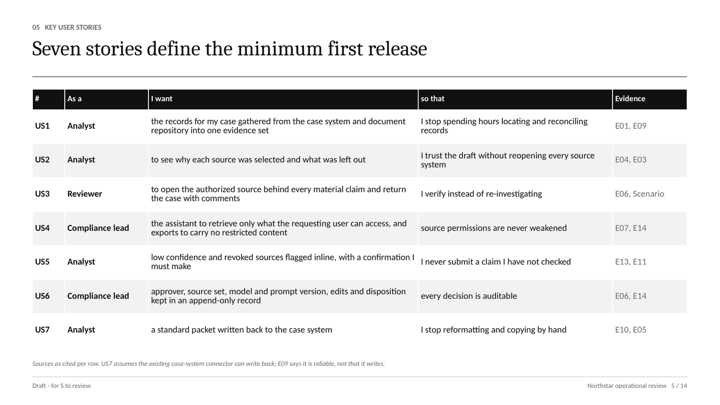
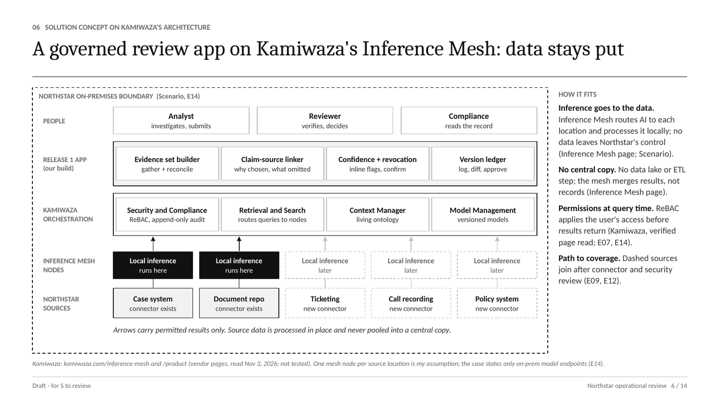
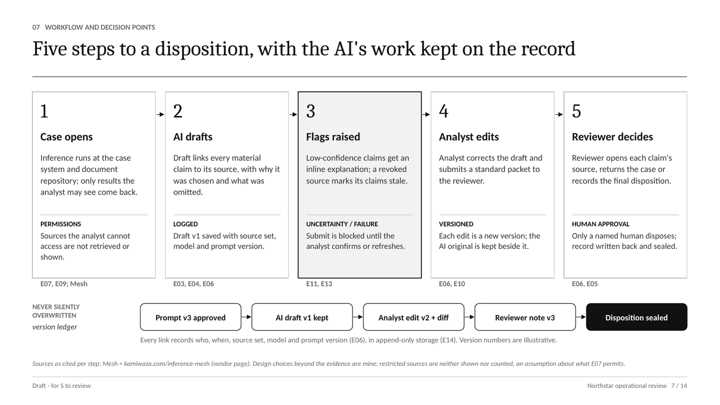
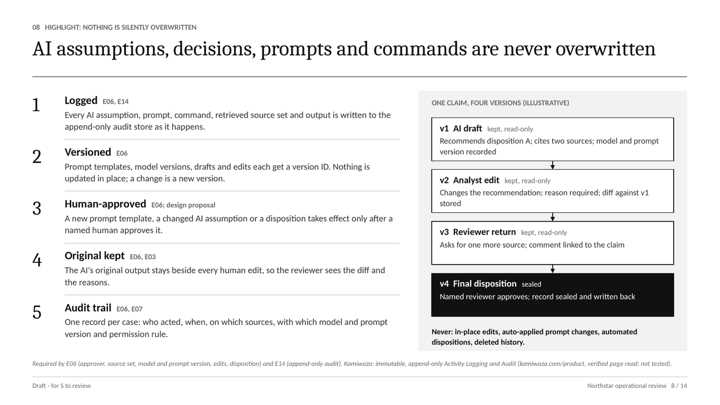
Word for word: Candidate Instructions, AI use: “one suggestion you accepted and why;” “one suggestion you rejected or corrected and why; and”. Product Brief Template, AI working notes: “Summarize one AI suggestion you accepted, one you rejected or corrected, and how you verified the work.”
Left empty on purpose: only S's own words from her recorded session go here. Typing here saves in this browser only, and the same boxes fill in on every tab.
Important
The instructions require the working session to be recorded continuously (screen, camera, microphone), with AI use visible.
They state: “Human assistance is not permitted.” The brief and the mock should be produced by you in your recorded session.
They also say: “Start recording before you open the case materials.” If that matters for how you start, the invitation is the place to ask.
This tracker is your reference and prep environment, not a draft of the submission.
Principal Product Manager Customer Exercise — Candidate Instructions
Principal Product Manager customer exercise
Purpose
This exercise helps us understand how you turn an ambiguous customer problem into a focused product decision. We are looking at how you use evidence, make tradeoffs, work with AI, and explain what you would ship and learn next. The case is synthetic. There is no hidden answer and no expectation that you know Kamiwaza’s product in advance.
What to submit
Submit all of the following:
A product brief of no more than 1,000 words, using the provided template or a document with the same sections.
A low-fidelity workflow mock with four to six frames. Include at least one uncertainty, failure, or permissions state.
A recording of your complete working session.
Any source files needed to view the brief and mock. PDF is preferred for the final brief and mock.
You may also submit a small working prototype. It is optional but encouraged. We will evaluate it as another way to communicate and test your thinking; the prototype itself is not scored separately.
Recording requirements
Record your full screen, camera, and microphone for the entire working session. We require all three because the working process is a primary part of the assessment.
Start recording before you open the case materials.
Aim for 60 minutes of recorded work. You may use up to 90 minutes.
Upload time does not count toward the limit.
Keep the recording continuous whenever possible. Do not edit it into a polished presentation.
If recording fails, resume immediately in a clearly numbered second segment and explain what happened.
Use a clean desktop and close personal or confidential applications before recording.
AI use
You are required to use an AI tool during the exercise. You may choose the tool. Keep your prompts, the AI’s responses, your edits, and your verification visible in the recording. Talk through:
how you give the AI context and constraints;
what you delegate and what you decide yourself;
how you inspect, challenge, and verify its work;
one suggestion you accepted and why;
one suggestion you rejected or corrected and why; and
The quality of a generated document is not enough by itself. We are interested in how effectively you direct the tool and retain ownership of the decisions. Human assistance is not permitted.
Recommended working sequence
Read the customer scenario and evidence pack.
State the customer problem and the evidence you consider most important.
Decide what the first release should and should not do.
Write the brief and create the four-to-six-frame workflow.
Verify the proposal against the technical, compliance, capacity, and timing constraints.
Walk through the result, the key tradeoffs, what you would validate next, and your AI decisions.
Use the evidence IDs when supporting material decisions. Distinguish supplied facts from your assumptions, and explain how an unresolved assumption affects the first-release choice.
Upload
Upload the recording, final brief, mock, and source files to the submission folder in your invitation. Accepted formats are MP4, MOV, PDF, DOCX, PPTX, PNG, JPG, Figma export, HTML, and ZIP. Do not upload credentials, private source material, or dependency directories.
Kamiwaza uses the submission only for hiring evaluation. Access is limited to the hiring team, and the submission is scheduled for deletion 90 days after the final decision. If you need an adjustment or encounter a technical problem, reply to the invitation before the deadline.
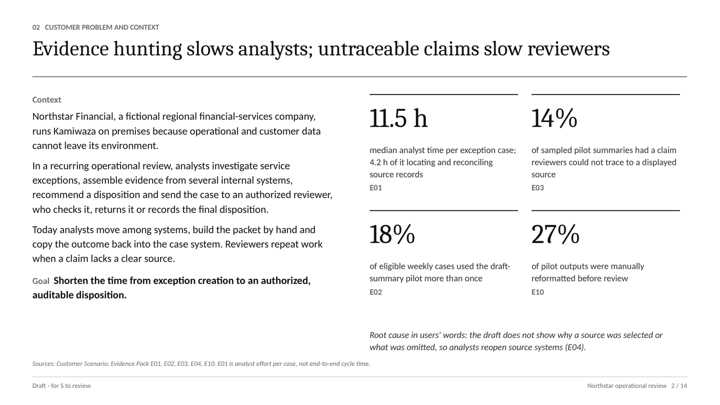
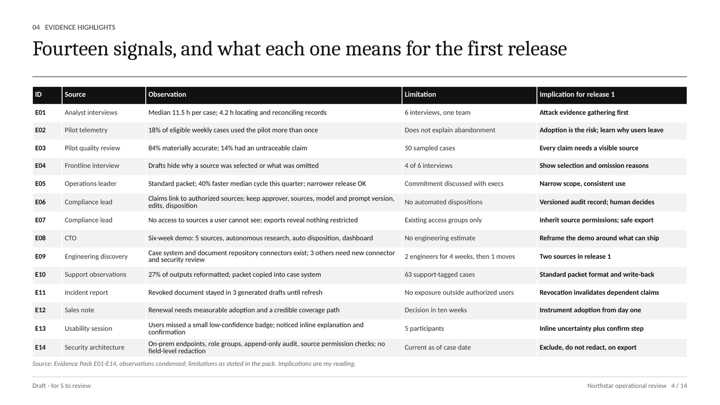
Analysts spend a median 11.5 hours on each exception case; 4.2 hours are spent locating and reconciling source records.
Six interviews from one operations team
E02
Pilot telemetry
18% of eligible weekly cases used the draft-summary pilot more than once.
Eight-week pilot; usage instrumentation does not explain abandonment
E03
Pilot quality review
84% of sampled summaries were judged materially accurate; 14% contained at least one claim reviewers could not trace to a displayed source.
Fifty sampled cases; reviewers used the current manual standard
E04
Frontline interview
Analysts value a starting draft but reopen source systems because the draft does not show why a source was selected or what was omitted.
Repeated in four of six interviews
E05
Operations leader
Standardize the final review packet and reduce median case cycle time by 40% this quarter. The leader would accept a narrower first release if it is used consistently.
Commercial commitment has already been discussed with executives
E06
Compliance lead
Every material claim must link to an authorized source. The system must preserve the human approver, source set, model and prompt version, edits, and final disposition in an auditable record.
Compliance has not approved automated dispositions
E07
Compliance lead
A user must not see or retrieve a source they could not access in the underlying system. Exported packets must not reveal restricted source content.
Existing access groups are available; a new identity system is not
E08
CTO
The six-week executive demo should show ingestion from all five source systems, autonomous research, automatic disposition, and a configurable executive dashboard.
No engineering estimate has been completed
E09
Engineering discovery
Reliable connectors already exist for the case system and document repository. The ticketing, call-recording, and policy systems would each require a new connector and security review.
Two engineers are available for four weeks before one moves to another commitment
E10
Support observations
27% of pilot outputs are manually reformatted before review. Users also copy the final packet into the case system.
Based on 63 support-tagged cases
E11
Incident report
In three pilot cases, a revoked document remained in an already generated draft until the user refreshed the evidence set.
No customer data was exposed outside authorized users
E12
Sales note
Northstar's renewal sponsor wants proof of measurable adoption and a credible path to broader source coverage, not necessarily all five connectors at launch.
The renewal decision is in ten weeks
E13
Designer usability session
Users missed low-confidence language presented only as a small badge. They noticed an inline explanation and a required confirmation step.
Five participants
E14
Security architecture
The deployment has on-prem model endpoints, role groups, append-only audit storage, and source-system permission checks. It does not have field-level redaction across all sources.
Architecture review is current as of the fictional case date
The PDF has no title above the table; it is reproduced as it appears.
Northstar Financial is a fictional regional financial-services company. It runs Kamiwaza on premises because operational and customer data cannot leave its environment. Northstar wants to improve a recurring operational review in which analysts investigate service exceptions, assemble evidence from several internal systems, recommend a disposition, and send the case to an authorized reviewer.
Each case starts when an operational exception needs a documented decision. An analyst must determine what happened, find and reconcile the relevant records, distinguish reliable evidence from unresolved uncertainty, and prepare a recommendation. An authorized reviewer then checks the evidence, returns the case for more work when needed, and records the final disposition. Today analysts move among several systems, manually assemble the review packet, and copy the outcome back into the case system. Reviewers may need to repeat parts of the investigation when a claim lacks a clear source or the packet does not explain what was omitted.
Northstar wants to shorten the time from exception creation to an authorized, auditable disposition. The first release should reduce the effort spent finding and reconciling evidence, make the review packet more consistent, and let a reviewer verify every material claim without weakening source permissions or human approval. The company also needs measurable adoption and a credible path to broader source coverage before an upcoming renewal decision.
The current pilot can retrieve internal material and draft a case summary. Leadership wants a credible first release in six weeks. The delivery team available for the first four weeks is two engineers and one product designer. Broader integrations, model training, and new identity infrastructure are unavailable in that window.
Your assignment
Define a first release that makes the review materially faster without weakening traceability, access control, or human accountability.
Prepare:
a product brief of no more than 1,000 words;
a four-to-six-frame low-fidelity workflow mock, including at least one uncertainty, failure, or permissions state; and
a recorded explanation of your decisions and AI-assisted working process.
Your brief should make clear the customer problem, target user, evidence, assumptions, first-release requirements, non-goals, workflow, human decision points, enterprise constraints, measures, next validation, and response to commercial pressure. Cite the supplied evidence IDs behind material decisions. You may identify missing evidence and propose how to obtain it. Do not invent customer facts to make the decision easier.
Four things: a product brief (max 1,000 words, template sections), a 4-6 frame low-fidelity workflow mock with at least one uncertainty, failure or permissions state, a recording of the complete working session, and any source files needed to view them (PDF preferred). A small working prototype is optional but encouraged.
Source: Candidate Instructions: What to submit
How long should the recorded session be?
Aim for 60 minutes of recorded work; you may use up to 90. Upload time does not count. Keep it continuous and unedited; if it fails, resume immediately in a clearly numbered second segment and explain what happened.
Full screen, camera and microphone, for the entire working session. Start before you open the case materials. Clean desktop, personal and confidential apps closed.
Six points: how you give the AI context and constraints; what you delegate vs decide; how you inspect, challenge and verify; one suggestion you accepted and why; one you rejected or corrected and why; any material uncertainty that remains. Prompts, responses, edits and verification must be visible.
Source: Candidate Instructions: AI use
Can anyone help me?
No. The instructions say: "Human assistance is not permitted." An AI tool is required, chosen by you.
Source: Candidate Instructions: AI use
When is the deadline?
Not stated in any of the four PDFs. It is in your invitation; the instructions only say to reply to the invitation before the deadline if you need an adjustment.
Source: Candidate Instructions: Upload
What is the delivery capacity I must design for?
Two engineers and one product designer for the first four weeks; one engineer then moves to another commitment (E09 limitation). Leadership wants a credible first release in six weeks. Broader integrations, model training and new identity infrastructure are unavailable in that window.
Source: Customer Scenario; E09
Which source systems can the first release realistically use?
The case system and document repository already have reliable connectors. Ticketing, call-recording and policy systems would each need a new connector and a security review.
Source: E09
What does the CTO want, and how does it compare to the ops leader?
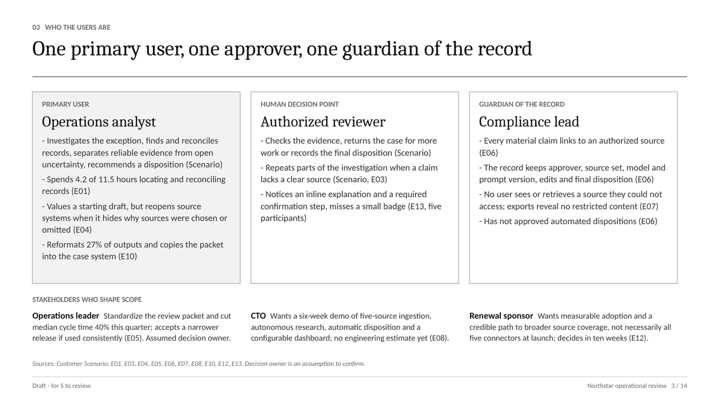
CTO (E08): a six-week executive demo showing ingestion from all five sources, autonomous research, automatic disposition (conflicts with RULE; not planned) and a configurable executive dashboard; no engineering estimate exists. Ops leader (E05): standardize the final review packet and cut median cycle time 40% this quarter, and would accept a narrower first release if used consistently.
Source: E08, E05
Can the product make the disposition automatically?
The evidence says compliance has not approved automated dispositions, and the scenario requires human approval and an authorized reviewer to record the final disposition.
Source: E06; Customer Scenario
What must the audit record contain?
The human approver, source set, model and prompt version, edits, and final disposition, in an auditable record. Every material claim must link to an authorized source.
Source: E06
What are the access-control rules?
A user must not see or retrieve a source they could not access in the underlying system, and exported packets must not reveal restricted source content. Existing access groups are available; a new identity system is not. There is no field-level redaction across all sources.
Source: E07, E14
What happened in the revoked-document incident?
In three pilot cases, a revoked document remained in an already generated draft until the user refreshed the evidence set. No customer data was exposed outside authorized users.
Source: E11
Where does time go for analysts today?
A median 11.5 hours per exception case, of which 4.2 hours go to locating and reconciling source records (six interviews, one team).
Source: E01
Why do analysts not trust the current draft?
They value a starting draft but reopen source systems because it does not show why a source was selected or what was omitted (four of six interviews). 14% of sampled summaries had at least one claim reviewers could not trace to a displayed source.
Source: E04, E03
How well is the pilot being adopted?
18% of eligible weekly cases used the draft-summary pilot more than once over an eight-week pilot; the instrumentation does not explain abandonment, which is missing evidence you can name.
Source: E02
How accurate is the pilot?
84% of fifty sampled summaries were judged materially accurate; 14% contained at least one untraceable claim.
Source: E03
What wastes effort after the draft is produced?
27% of pilot outputs are manually reformatted before review, and users copy the final packet into the case system (63 support-tagged cases).
Source: E10
How should low confidence be shown?
Users missed low-confidence language shown only as a small badge; they noticed an inline explanation and a required confirmation step (five participants).
Source: E13
What does the renewal sponsor need, and when?
Proof of measurable adoption and a credible path to broader source coverage, not necessarily all five connectors at launch. The renewal decision is in ten weeks.
Source: E12
What does the security architecture already provide?
On-prem model endpoints, role groups, append-only audit storage and source-system permission checks. It does not have field-level redaction across all sources.
Source: E14
Why is Northstar on premises?
Operational and customer data cannot leave its environment.
Source: Customer Scenario
What sections does the brief need?
Header: working title, primary user, decision owner. Sections: Problem and evidence; First-release proposal; Requirements; Non-goals; Workflow and decision points; Technical and enterprise considerations; Measures and validation; AI working notes.
Source: Product Brief Template
Can I add facts that make the case easier?
No: "Do not invent customer facts to make the decision easier." You may identify missing evidence and propose how to obtain it, and you must distinguish supplied facts from assumptions.
Source: Customer Scenario; Candidate Instructions
Is there a right answer or do I need to know Kamiwaza's product?
The case is synthetic, there is no hidden answer, and there is no expectation that you know Kamiwaza's product in advance.
Source: Candidate Instructions: Purpose
No match. Ask Tab on WhatsApp instead.
Kamiwaza company context
Background on the real company, for your later phases. The exercise itself says no prior knowledge of Kamiwaza's product is expected and the case is synthetic.
Compiled 2026-11-03 (UTC ~14:45). Pages fetched and read this session unless marked 'unverified (search snippet only)'. 'Stated on ... page' means the page says so; it does not mean the claim was tested. Crunchbase (403) and Intel customer story (403) could not be read. LinkedIn profile pages are login-walled; only public post text and search snippets were readable. Items marked unverified come from search snippets or could not be confirmed.
Company
Kamiwaza AI (Kamiwaza Corp.) sells a 'secure AI orchestration platform' that runs AI (models, RAG, agents) where enterprise data already lives - on-prem, cloud, edge - instead of centralizing data, with relationship-based access control (ReBAC) and full audit logging. Positioned for regulated industries and federal/government.
Self-description: 'the first distributed AI orchestration platform that processes intelligence where data lives' stated on Kamiwaza's page (read Nov 3, 2026) https://www.kamiwaza.ai/about
Matthew Probst (most likely; unverified as current)
Described as 'KamiwazaAI's Technical Chief of Staff' in a public LinkedIn post by Oliver B. (~1 year old, about Sept 2025) about a panel on 'how AI is supporting transformation of financial institutions' (hosted by IgniteGTM, Supermicro, NVIDIA). His current LinkedIn headline/ZoomInfo title reads 'GM - Kamiwaza Federal & Chief Information Security Officer (CISO)'.
Kamiwaza does not list a Chief of Staff on its own site (About page lists only Luke Norris and Matt Wallace). A Jan 2025 job posting was for a 'Technical Chief of Staff to CTO' - working directly with CTO/co-founder Matt Wallace: code reviews, architecture, technical docs, hands-on development, hiring, prioritizing technical initiatives, managing CTO time; remote, company based in Silverthorne CO (source: https://www.coloradoai.news/featured-ai-job-technical-chief-of-staff-to-cto-at-kamiwaza/). Separately, Chelsea H. lists 'Chief of Staff to CEO at Kamiwaza' (snippet). S should confirm the presenter's name from her invitation/recruiter.
post text stated on the linked page (read Nov 3, 2026); current title unverified (snippets); whether he still holds the Technical CoS role is unverified
Matthew Probst — GM - Kamiwaza Federal & Chief Information Security Officer (CISO); earlier described as Technical Chief of Staff (see below) unverified (search snippet only) - LinkedIn profile confirms he is at KamiwazaAI (page read) but title text is hidden behind login https://www.linkedin.com/in/cloudleader · https://www.zoominfo.com/p/Matthew-Probst/1229865199(may need login / paywalled; snippet only)
Editions / pricing — Community Edition $0 (open download on GitHub), Flex Edition $25,000/yr, Starter Edition $75,000/yr, Enterprise Edition $125,000/yr; editions differ by nodes, GPU/VRAM limits, security controls, and number of 'Guaranteed Outcomes per year' (outcome-based support). Price parse from the page was slightly garbled - confirm on page. stated on Kamiwaza's page (read Nov 3, 2026) (figures as parsed) https://www.kamiwaza.com/partner-ecosystem · https://github.com/kamiwaza-ai
Context Manager & living ontology — Automatically discovers data and maps relationships into a continuously updated knowledge graph across sources (structured and unstructured incl. images, video, handwritten notes) stated on Kamiwaza's page (read Nov 3, 2026) https://www.kamiwaza.com/context-manager · https://www.kamiwaza.com/product
Permission-aware retrieval (ReBAC) — Orchestration layer applies the user's ReBAC permissions to filter what can be returned; every agent operates in a named user context and can only access what that user can; permissions resolved at query time (dynamic), no accumulation of permissions across sessions stated on Kamiwaza's page (read Nov 3, 2026) https://www.kamiwaza.ai/insurance/it/architecture
ReBAC vs RBAC/ABAC positioning — Evaluates relationships at execution time (department, project, team, delegated authority, data domain, operating context); argues RBAC/ABAC insufficient for agents; ReBAC whitepaper 'The inference firewall' stated on Kamiwaza's page (read Nov 3, 2026) (security page); whitepaper PDF title from snippet https://www.kamiwaza.com/security-and-compliance · https://www.kamiwaza.ai/hubfs/ReBAC.pdf
Audit trail — Activity Logging and Audit: user actions, system events and AI agent activities with immutable, append-only logging; per agent action logs user context, data accessed, permission rule applied, timestamp; traces user activity, agent activity, authorization decisions, execution events and released outputs as one continuous record stated on Kamiwaza's page (read Nov 3, 2026) https://www.kamiwaza.com/product · https://www.kamiwaza.ai/insurance/it/architecture · https://www.kamiwaza.com/security-and-compliance
Retrieval / RAG stack — Retrieval Service (one service across connected sources), Embedding and Vector Service, Semantic Search (semantic + keyword + knowledge-graph traversal with summarization), Data Catalog with DataHub integration stated on Kamiwaza's page (read Nov 3, 2026) https://www.kamiwaza.com/product
Classification & security markings — Standardized markings for federal and defense classification requirements stated on Kamiwaza's page (read Nov 3, 2026) https://www.kamiwaza.com/product
Developer surface — OpenAI-compatible APIs, Model Context Protocol (MCP) extensibility, Python SDK, JupyterLab 'Lab Notebook', model management incl. Hugging Face discovery, llama.cpp/vLLM engines stated on Kamiwaza's page (read Nov 3, 2026) https://www.kamiwaza.com/product · https://www.kamiwaza.com/partner-ecosystem
Legacy / mainframe connectors — COBOL, IMS, DB2, VSAM; policy admin platforms (Duck Creek, Guidewire, Majesco); SharePoint, file shares, email; documents processed in place with visual language models stated on Kamiwaza's page (read Nov 3, 2026) https://www.kamiwaza.ai/insurance/it/architecture
IAM integration — Financial-services page: 'Natively integrate with your existing IAM infrastructure. Every AI agent authenticates like a human user. RBAC extends to AI.' stated on Kamiwaza's page (read Nov 3, 2026) https://www.kamiwaza.com/financial-services
2025-01-30 — Presented at AI Field Day 6 (also HPE presented with Kamiwaza at AI Field Day 7, Oct 29, 2025) unverified (search snippet only) https://techfieldday.com/companies/kamiwaza-ai/
2025-11-12 — Town of Vail, CO 'agentic smart city' coverage (Route Fifty), with HPE Agentic Smart City Solution stated on Kamiwaza's page (read Nov 3, 2026) (newsroom listing) https://www.kamiwaza.com/newsroom
2025-12-18 — Kamiwaza platform on NVIDIA DGX Spark stated on Kamiwaza's page (read Nov 3, 2026) (newsroom listing) https://www.kamiwaza.com/newsroom
2026-04-21 — ARIA 508 accessibility agent available via TD SYNNEX and HPE stated on Kamiwaza's page (read Nov 3, 2026) (newsroom listing) https://www.kamiwaza.com/newsroom
2026-08-10 — Named a Sample Vendor for Agentic AI in Smart Cities in Gartner Hype Cycle for Smart City Technologies and Solutions, 2026 stated on Kamiwaza's page (read Nov 3, 2026) (newsroom listing) https://www.kamiwaza.com/newsroom
2026-09-10 — Powers new Signal65 PINNACLE AI benchmark (independent benchmarking framework co-developed with Kamiwaza) stated on Kamiwaza's page (read Nov 3, 2026) (newsroom listing) https://www.kamiwaza.com/newsroom
Claims to govern the full request-to-result chain (user -> agent -> metadata/embeddings -> model/node -> released output) vs point solutions strong at only one layer (identity, model gateway, runtime, observability) stated on Kamiwaza's page (read Nov 3, 2026) https://www.kamiwaza.com/security-and-compliance
No named-competitor comparison was found on Kamiwaza's own pages read. Third-party lists put the category near Palantir AIP, Databricks, Snowflake, Microsoft, ServiceNow - not verified as Kamiwaza's own framing unverified https://www.elementum.ai/blog/palantir-alternative
Permission-aware retrieval is the product's core security story: agents inherit exactly the requesting user's permissions, resolved at query time; results filtered by ReBAC before return stated on Kamiwaza's page (read Nov 3, 2026) https://www.kamiwaza.ai/insurance/it/architecture
Revocation angle: because permissions resolve at query time, a relationship change (e.g. territory change) changes agent access immediately with no permission update; relevant to any 'revoked document still surfaced' scenario - but this is a vendor claim; latency of source-system permission sync is not documented in what was read vendor claim; sync details unverified https://www.kamiwaza.ai/insurance/it/architecture
Kamiwaza's own security page concedes gaps others leave: 'Protection of source data does not automatically cover metadata, embeddings, or other derived knowledge assets' and 'Logging after the fact does not prevent overexposure at the point of answer generation' - useful language for a brief on derived-data/embedding leakage stated on Kamiwaza's page (read Nov 3, 2026) https://www.kamiwaza.com/security-and-compliance
Financial services is a named vertical: fraud, risk, trading, document processing (loan applications, trading agreements, compliance reports); unnamed case studies (global investment bank -75% trade settlement exceptions; regional credit union; insurance conglomerate) - anonymous vendor claims page verified; case-study numbers unverified vendor claims https://www.kamiwaza.com/financial-services
Kamiwaza's own hypothetical FS workflow: AI-assisted investigation routed to an authorized inference environment near governed data, returning 'permitted results, supporting sources, and relevant provenance'; explicitly says placement 'does not establish compliance' - legal, risk ownership, testing and human oversight remain essential stated on Kamiwaza's page (read Nov 3, 2026) https://www.kamiwaza.ai/insights/distributed-ai-inference-enterprise-architecture
Commercial model includes 'Guaranteed Outcomes per year' and quarterly value reviews - outcome-led selling; renewal framing in the exercise maps to this stated on Kamiwaza's page (read Nov 3, 2026) https://www.kamiwaza.com/partner-ecosystem
Docs (docs.kamiwaza.ai) have Quickstart, Installation, Security (authentication, authorization, access control), Models, App Garden sections; Community Edition and client SDK are on GitHub - S could stand up a demo environment from Community Edition (check hardware requirements first) stated on Kamiwaza's page (read Nov 3, 2026) https://docs.kamiwaza.ai/ · https://github.com/kamiwaza-ai
The working demo on fictional sample data, end to end: open case, sources, draft packet, submit re-check, reviewer decision, audit and export. Start here when presenting.
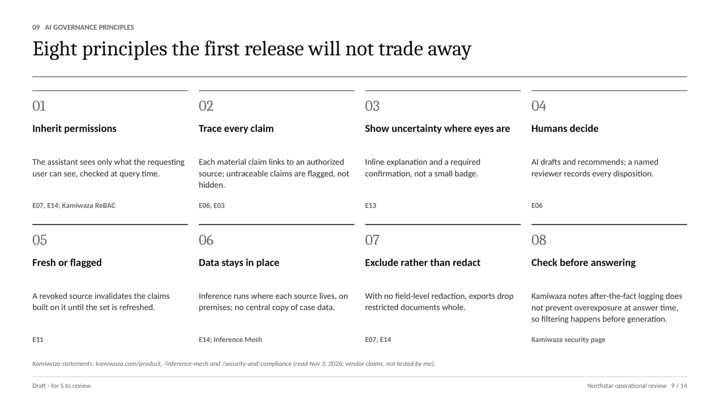
RULE(S): Never fully automatic. In every release, now and in future, disposition is governed by humans in multiple layers. Release 1: a named human records the final disposition; the system never does. Later releases may add assistance, but never remove the human layers. [E06]Full rule and S's words
Version note: v2 (layered for cross-functional readers), v1 kept below/linked. v1 is unchanged and stays on the PRD (v1) tab. Following S's never-overwritten principle, v2 is a new version, not an edit of v1. Draft by Tab for S to review; the submission brief and mock still come from S's own recorded session [Instructions].
How to read: everyone reads Part 1. Then jump to your team. References: E01-E14 are the case evidence, A1-A19 assumptions, N1-N15 unknowns, R1-R15 requirements. Kamiwaza statements are labeled as Kamiwaza's own claims.
1. For everyone
Start here. This part has no jargon. Every other part of the PRD builds on it.
The problem, in one paragraph
Northstar Financial (a fictional regional financial-services company in the case) has analysts who look into "service exceptions", meaning cases where something went wrong for a customer. For each case they gather evidence from several internal systems, write up what happened, suggest an outcome, and send it to a reviewer who signs it off. Today this is slow. A case takes a median of 11.5 hours, and 4.2 of those hours go just to finding and matching up records [E01]. An AI helper was piloted, but people rarely came back to it: only 18% of eligible weekly cases used it more than once [E02]. Reviewers could not always check where a statement came from [E03, E04], and outputs were often retyped by hand [E10].
Who it is for
Analysts, who investigate each case and prepare the review packet [Scenario ¶1].
Reviewers, who check the evidence, send a case back if needed, and record the final outcome [Scenario ¶2].
Around them: the operations leader who wants faster, standard packets [E05], compliance, who protects the audit record and access rules [E06, E07], the CTO, who wants an impressive demo [E08], and the renewal sponsor, who decides in ten weeks whether Northstar keeps buying [E12].
What we build first
A review packet the reviewer can trust without redoing the work. It uses only the two systems that already connect reliably, the case system and the document repository [E09]. In the packet:
every important statement links to its source [E03, E06];
it shows what was searched, what was used and what was left out, and why [E04];
anything uncertain is explained in place and has to be confirmed by a person [E13];
people only ever see documents they are already allowed to see, re-checked whenever the packet is opened, submitted or exported [E07, E11];
a human always records the final decision. In Release 1 this is a rule, and the process is never 100% automatic [E06, S's rule].
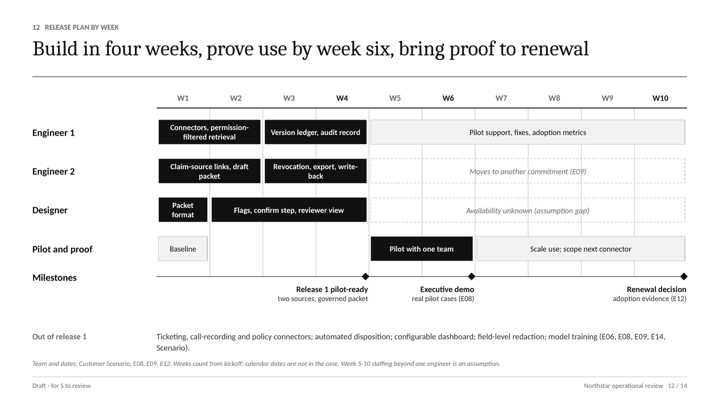
It fits a team of two engineers and one designer for four weeks [Scenario ¶4, E09]. It lands at week 6 as the release and the executive demo, which leaves about four weeks of real use before the renewal decision [E12, A6, A8].
Why it is safe
The data never leaves Northstar. Northstar runs Kamiwaza on its own premises because its data cannot leave its environment [Scenario ¶1]. The AI works where the data already sits, on Northstar's own machines, and no central copy is made. (This is how Kamiwaza describes its own Inference Mesh; it is Kamiwaza's claim, read on its site [kamiwaza.com/inference-mesh · Kamiwaza's own claim].)
Nobody sees more than they already could. Access follows the permissions people already have in the source systems [E07, E14].
Nothing the AI did is quietly rewritten. Every AI assumption, decision, prompt and command is logged and versioned. A change creates a new version that a person approves, and the original is kept [E06, E14, S's principle].
People decide. Compliance has not approved automatic decisions [E06], so the final outcome is always recorded by a person.
How we will know it worked
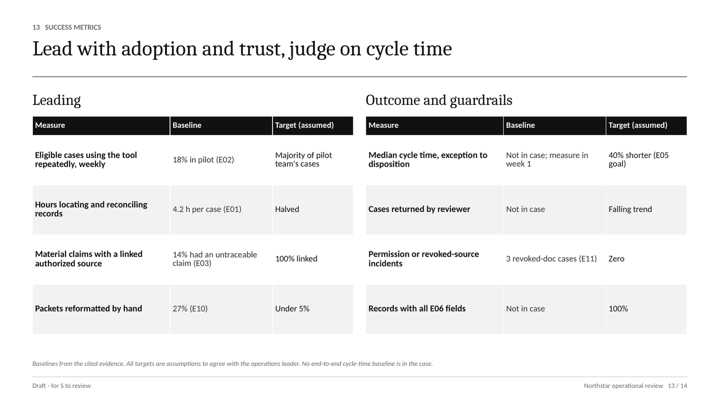
More analysts come back to it week after week, from a baseline of 18% [E02].
No packet goes out with an untraceable statement (today 14% of sampled summaries had one) [E03].
Less retyping and reformatting (today 27% of outputs) [E10].
Less time finding and matching records (today 4.2 hours) [E01], and shorter time from case opened to case decided. The operations leader's target is 40% shorter this quarter [E05].
Zero cases of someone seeing a document they should not [E11], and a complete audit record on every packet [E06].
Short glossary
Permission-aware retrieval: the AI only looks up and shows documents the person asking is already allowed to open in the original system, checked at the moment of asking [E07, E14].
Inference Mesh: Kamiwaza's name for running AI models where the data lives, across sites, instead of moving data to one central place. Kamiwaza's own claim: "all Inference Mesh processing happens locally within your secure environment" [kamiwaza.com/inference-mesh · Kamiwaza's own claim].
Audit trail: a permanent, append-only record of who did what, when, with which sources, model and prompt version, so it can be checked later and cannot be rewritten [E06, E14].
Disposition: the final outcome of a case (for example, approved or resolved), recorded by the authorized reviewer [Scenario ¶2, E06].
Confidence: how sure the system is about a finding. Low confidence must be explained in plain words next to the finding and confirmed by a person, not hidden in a small badge [E13].
Material claim: a factual statement in the findings or recommendation that a reviewer relies on. This is our working definition, to be confirmed with compliance [A12, N10].
Evidence ID (E01-E14): the reference numbers of the facts supplied in the case's evidence pack. A1-A19 are our assumptions and N1-N15 are known unknowns (see the engineering section).
2. Non-tech teams, compliance and audit
What you need to know: what the system will and will not do, what an auditor can check, and where the gaps are.
What the system will never do
Record a final disposition without a human, in any release. This is the RULE at the top of this page: never fully automatic; humans govern disposition in multiple layers [E06].
Show or export content the person could not open in the source system [E07].
Quietly overwrite what the AI produced. Each change is a new version that a person approves, and the original stays in the record [E06, E14, S's principle].
Do autonomous research, where the AI goes off and decides alone [E06, E08].
What an auditor can check, per packet
The auditable record keeps, as E06 requires [E06, R9]:
the human approver;
the source set (which documents, which versions);
the model and prompt version used (capture assumed possible, to confirm in week 1) [A9];
every edit, with the original kept;
the final disposition and who recorded it.
It is written to the append-only audit storage Northstar already has, so history cannot be rewritten [E14].
Controls mapped to the evidence
Risk
Control in Release 1
Reference
Untraceable statement reaches a reviewer
Citation gate: a packet cannot be submitted with an unsourced material claim
E03, E06, R3
Someone sees a restricted document
Retrieval runs as the requesting user with existing access groups
E07, E14, R2
Revoked document stays in a draft (happened in 3 pilot cases)
Permissions re-checked on open, submit and export; dependent claims flagged
E11, A4, R6
Export leaks restricted content
Restricted sources withheld entirely, and the packet says something was withheld
E07, E14, A5, R10
Uncertain finding goes unnoticed
Inline explanation plus required confirmation
E13, R5
AI output silently changed
Versioned change control with human approval; original kept
E06, R12
Known gaps (said plainly)
No field-level redaction across all sources in the deployment [E14], so we withhold whole sources instead [A5].
How fast permission changes reach the system is not known [N9]. Kamiwaza claims revocation takes effect immediately because permissions resolve at query time; that is Kamiwaza's claim and unverified.
Kamiwaza's own security page says protecting source data does not automatically cover derived data such as embeddings, and logging after the fact does not prevent over-exposure at answer time (Kamiwaza's own statement, page read). Our re-checks and references-not-copies design respond to this [R6, R13, A18].
HIPAA and SOC 2 support are Kamiwaza's claims, unverified.
What we need from you (week 1)
Confirm what counts as a "material claim" [A12, N10].
Witness a test of the revoked-document re-check, like the E11 incident [A4, E11].
3. Business teams and investors
What you need to know: the value, how we measure it, and the renewal risk.
The value
Time: a median 11.5 analyst hours per case, 4.2 of them spent finding and reconciling records [E01]. That 4.2 hours is the part we target first [A3].
Trust that drives reuse: today only 18% of eligible weekly cases use the pilot more than once [E02]. 14% of sampled summaries had a claim reviewers could not trace [E03], and analysts reopen source systems because drafts do not show what was chosen or left out [E04]. We assume trust and rework are the main reasons for low reuse [A2].
Rework: 27% of outputs are reformatted by hand, and users copy final packets into the case system [E10].
Without new risk: no new identity system, no new connectors, data stays on premises [E07, E09, Scenario ¶1].
The renewal risk (E12)
The renewal decision is in ten weeks. The sponsor wants proof of measurable adoption and a credible path to broader source coverage, not necessarily all five connectors at launch [E12].
Release and demo at week 6 leave about four weeks of real usage data before renewal, if both clocks start on the same day [A6, A8]. Calendar dates are not in the case [N7].
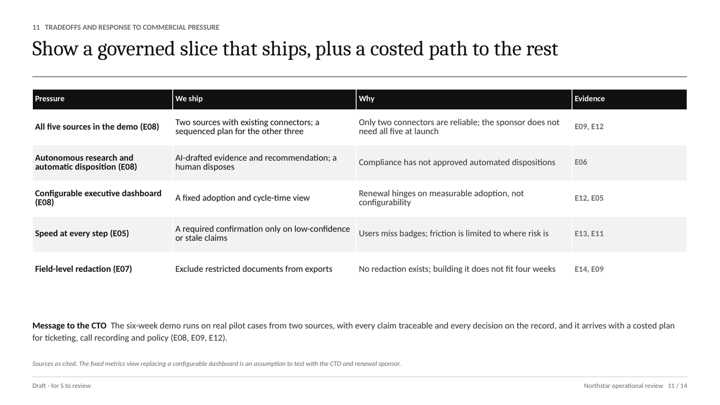
Biggest risk: chasing the CTO's demo list (all five systems, autonomous research, automatic disposition (conflicts with RULE; not planned), configurable dashboard) with no engineering estimate [E08]. That conflicts with compliance [E06] and connector capacity [E09], and could leave nothing real by week 10.
Our answer: demo the real, governed workflow on two sources, with early adoption numbers and a dated connector roadmap with security reviews [E09, E12]. The operations leader already accepts a narrower first release if it is used consistently [E05].
The operations leader's 40% cycle-time cut "this quarter" is tied to a commercial commitment discussed with executives [E05]. When the quarter ends and exactly what was promised are not known [N6].
Metrics in plain terms
What we watch
Today
Goal
Reference
Repeat use (cases using it more than once a week)
18%
Clearly above 18% by week 10 (proposal, to agree)
E02, A16
Packets with an untraceable claim
14% of sampled
Zero (enforced)
E03
Packets reformatted by hand
27%
Under 10% (proposal)
E10, A16
Hours finding and reconciling
4.2 h median
Measurable drop (proposal)
E01, A16
Time from case opened to decision
Not known
40% lower (operations leader's target)
E05, N3
Permission incidents
3 pilot cases
Zero
E11
Targets other than the 40% are proposals, not customer facts [A16].
Why this matters beyond Northstar
Regulated customers cannot move their data. Kamiwaza positions itself as running AI where data already sits (on-prem, cloud, hybrid, edge) without copying it into one central store; that is Kamiwaza's own positioning, from its site and the research file. A governed, auditable workflow is the proof point such buyers ask for. Northstar itself is fictional [Scenario ¶1].
What we need from you
Agree the week-6 demo scope with the CTO in writing, in week 1 [E08, E05].
Find out who the renewal sponsor is and what "credible path" means to them [N12].
4. Product team and adjacent teams
What you need to know: the problem statement, the scope decision, what to validate first, and who decides.
Problem statement
An analyst cannot hand a reviewer a packet the reviewer can verify without redoing the work. Evidence is spread across systems [Scenario ¶2, E01], drafts hide why sources were chosen or left out [E04], some claims are untraceable [E03], and packets are reformatted and retyped [E10].
Scope decision and trade-offs
In Release 1 (all P0): two-source evidence set, retrieval as the user, claim-level citations with a submit gate, sources panel, inline uncertainty with confirmation, permission re-check, one standard packet, reviewer actions with a human-recorded disposition, audit record, safe export, failure handling, AI change control, references not copies [R1-R13].
P1: usage instrumentation with an abandonment-reason prompt and a fixed adoption report [R14]; write-back to the case system if the connector supports it [R15, A11].
Out: autonomous research, new connectors, configurable dashboard, field-level redaction, model training, new identity infrastructure [E06, E08, E09, E14, Scenario ¶4].
Trade-off: depth and trust on two sources over breadth on five. This serves adoption and renewal [E05, E12] and fits the team [E09].
Shape of the release
Two engineers and one designer for weeks 1-4; one engineer moves after week 4 [E09, Scenario ¶4]. We assume weeks 5-6 are hardening and rollout only, with no new scope [A7]. Week 6 is both the release and the demo [A6]. We assume the pilot's retrieval and drafting can be extended rather than rebuilt [A10].
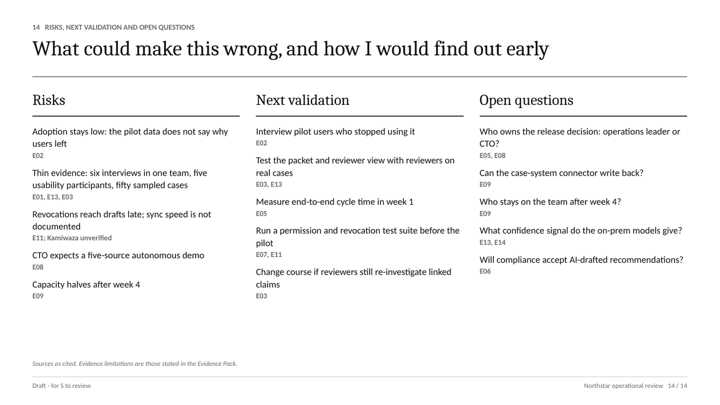
Validate first (week 1)
Where does each case's evidence live? If mostly outside the two connected systems, the first new connector moves up [A1, N1].
Why did pilot users stop? If it is not about trust or rework, fix that cause first [A2, N2].
Can permission checks run again at open, submit and export? [A4]
Can cycle time be measured from case-system timestamps? [A13]
Who decides
The operations leader owns product scope, and the authorized reviewer owns each case's disposition (assumption) [A15].
For adjacent teams
Support and customer success: expect less manual reformatting and copy-in work, which today shows up in support cases (E10 draws on 63 support-tagged cases) [E10]. Teach users what "withheld" and "needs confirmation" mean.
Sales and solutions: the demo is the governed workflow on two sources plus a dated connector roadmap, not all five systems [E08, E12]. Present Kamiwaza capabilities as Kamiwaza's own claims.
Enablement and training: the core habit is to check the sources panel and confirm uncertain findings [E04, E13].
Data and analytics: instrument repeat use and abandonment reasons from day one [E02, R14].
5. Design
What you need to know: the states that must be designed, what the evidence says about them, and the rules the UI must keep visible.
What the evidence tells design
A small low-confidence badge was missed. An inline explanation plus a required confirmation step was noticed (five participants) [E13].
Analysts reopen source systems because the draft does not show why a source was chosen or what was left out [E04].
27% of outputs are reformatted before review, so one standard, copy-ready packet matters [E10].
A revoked document stayed in a generated draft until refresh [E11].
States to design (at least one uncertainty, failure or permissions state is required in the mock)
State
What the user sees
Reference
Evidence assembled
Packet with a citation on every material claim
E06, R3
Sources panel
Searched, included, excluded, and why
E04, R4
Low confidence
Plain-words explanation in place, plus a Confirm or Change step
E13, R5
Untraced claim
Submit is blocked until the claim is sourced or removed
One designer for weeks 1-4; time after week 4 is not stated, so the plan assumes none [Scenario ¶4, A7], so all states above land by week 4. The 4-6 frame low-fi mock is drafted on the Materials tab.
6. Tech and engineering
What you need to know: everything. This section keeps the full v1 PRD content unchanged: every requirement (R1-R15), every Considered fact, every assumption (A1-A19) and every Not in scope / not known item (N1-N15), with all references. Only the anchor names changed so v1 and v2 can sit on the same page.
Key engineering rules, restated:
Release 1: a human always records the final disposition; it is never 100% automatic [E06, S's rule].
AI assumptions, decisions, prompts and commands are never silently overwritten: logged, versioned, human-approved, original kept [R12, S's principle].
Kamiwaza Inference Mesh: data stays put, inference runs locally, no central copy [R13, kamiwaza.com/inference-mesh · Kamiwaza's own claim]. Kamiwaza platform statements below are Kamiwaza's own claims, labeled stated on Kamiwaza's page (read Nov 3, 2026) or unverified.
Prep draft by Tab from the four PDFs, for S to review. Not the submission: the instructions require the brief and mock to come out of S's own recorded session [Instructions: recording, Instructions: AI use].
Considered fact from the PDFs, with its reference Assumed not in the PDFs, with the reason Not in scope / not known excluded or unknown
Principle: AI work is never silently overwritten
Every AI-generated assumption, claim, decision, prompt and command is logged and versioned. A change creates a new version; a human approves it; the original stays in the audit trail. [E06, E14]
Revoked document (E11): removing it from a draft creates a new version, flags the claims that relied on it, and needs the analyst's re-approval; the earlier version is kept, with the content itself withheld from anyone who has lost access. [E11, E07]
Low confidence (E13): an uncertain finding is confirmed or changed by a person, never auto-resolved; the confirmation is logged. [E13]
Security (E14): the record lives in the existing append-only audit storage, so history cannot be rewritten. [E14]
Kamiwaza's platform names "Activity Logging and Audit": an audit trail for user actions, system events and AI agent activities with immutable, append-only logging. [kamiwaza.com/product · stated on Kamiwaza's page (read Nov 3, 2026)]
Summary
Northstar's analysts lose hours finding and reconciling records [E01], and the pilot's drafts are not trusted enough to reuse [E02, E03, E04]. The first release turns the pilot into a governed review packet built from the two systems that already have reliable connectors [E09]: every material claim is cited [E06], omissions are explained [E04], uncertainty needs confirmation [E13], permissions are re-checked [E07, E11], and a human reviewer records the disposition [Scenario ¶2, E06]. It fits two engineers and one designer for four weeks [Scenario ¶4, E09] and lands as the week-6 release and demo, leaving about four weeks of usage data before the renewal decision [E12, A6, A8].
Working title (a naming choice, not a customer fact): Evidence-linked review packet. Primary user: operations analyst [Scenario ¶1, E01, E04]. Secondary user: authorized reviewer [Scenario ¶2]. Decision owner: operations leader for scope, reviewer for each disposition [A15].
Part A Considered: facts from the PDFs
Customer and context
Northstar Financial is a fictional regional financial-services company. [Scenario ¶1]
It runs Kamiwaza on premises because operational and customer data cannot leave its environment. [Scenario ¶1]
The workflow: analysts investigate service exceptions, assemble evidence from several internal systems, recommend a disposition, and send the case to an authorized reviewer. [Scenario ¶1]
The analyst must find and reconcile records and distinguish reliable evidence from unresolved uncertainty; the reviewer checks the evidence, returns the case for more work when needed, and records the final disposition. [Scenario ¶2]
Today analysts move among several systems, manually assemble the review packet, and copy the outcome back into the case system. [Scenario ¶2, E10]
Reviewers may repeat parts of the investigation when a claim lacks a clear source or the packet does not explain what was omitted. [Scenario ¶2, E04]
The current pilot can retrieve internal material and draft a case summary. [Scenario ¶4]
Goal stated by the customer
Shorten the time from exception creation to an authorized, auditable disposition. [Scenario ¶3]
The first release should reduce effort finding and reconciling evidence, make the packet more consistent, and let a reviewer verify every material claim without weakening source permissions or human approval. [Scenario ¶3]
Northstar also needs measurable adoption and a credible path to broader source coverage before an upcoming renewal decision. [Scenario ¶3, E12]
The assignment: a first release that makes the review materially faster without weakening traceability, access control, or human accountability. [Scenario: assignment]
Problem evidence
Analysts spend a median 11.5 hours per exception case; 4.2 hours go to locating and reconciling source records. Limitation: six interviews from one team. [E01]
18% of eligible weekly cases used the draft-summary pilot more than once. Limitation: eight-week pilot; instrumentation does not explain abandonment. [E02]
84% of sampled summaries were materially accurate; 14% contained at least one claim reviewers could not trace to a displayed source. Limitation: fifty sampled cases; reviewers used the current manual standard. [E03]
Analysts value a starting draft but reopen source systems because the draft does not show why a source was selected or what was omitted (four of six interviews). [E04]
27% of pilot outputs are manually reformatted before review; users copy the final packet into the case system (63 support-tagged cases). [E10]
In three pilot cases a revoked document stayed in an already generated draft until the user refreshed the evidence set; no customer data was exposed outside authorized users. [E11]
Users missed low-confidence language shown only as a small badge; they noticed an inline explanation and a required confirmation step (five participants). [E13]
Stakeholder asks (some conflict)
Operations leader: standardize the final review packet and cut median case cycle time by 40% this quarter; would accept a narrower first release if used consistently. A commercial commitment has been discussed with executives. [E05]
CTO: the six-week executive demo should show all five source systems, autonomous research, automatic disposition (conflicts with RULE; not planned), and a configurable executive dashboard. No engineering estimate exists. [E08]
Renewal sponsor: wants proof of measurable adoption and a credible path to broader source coverage, not necessarily all five connectors at launch. Renewal decision in ten weeks. [E12]
Constraints
RULE (S): never fully automatic. In every release, humans govern disposition in multiple layers; in Release 1 a named human records the final disposition and the system never does. [E06, RULE]
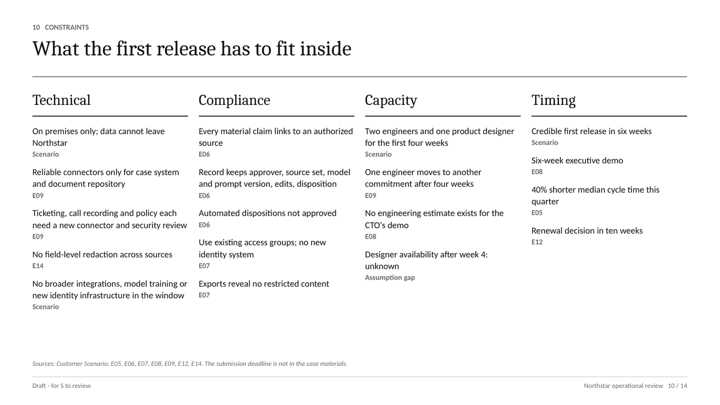
Every material claim must link to an authorized source; the system must keep the human approver, source set, model and prompt version, edits, and final disposition in an auditable record. Automated dispositions are not approved. [E06]
A user must not see or retrieve a source they could not access in the underlying system; exported packets must not reveal restricted content. Existing access groups are available; a new identity system is not. [E07]
Reliable connectors exist for the case system and document repository; ticketing, call-recording and policy systems each need a new connector and security review. [E09]
Two engineers are available for four weeks before one moves to another commitment. The delivery team for the first four weeks is two engineers and one product designer. [E09, Scenario ¶4]
Leadership wants a credible first release in six weeks; broader integrations, model training, and new identity infrastructure are unavailable in that window. [Scenario ¶4]
The deployment has on-prem model endpoints, role groups, append-only audit storage, and source-system permission checks; it lacks field-level redaction across all sources. [E14]
What the submission must show (from the instructions)
Brief of no more than 1,000 words with the template sections; 4-6 frame low-fi mock with at least one uncertainty, failure or permissions state. [Instructions: what to submit, Brief template]
Use evidence IDs for material decisions; distinguish supplied facts from assumptions; explain how an unresolved assumption affects the first-release choice; do not invent customer facts. [Instructions: sequence, Scenario: assignment]
Kamiwaza platform context (real company, not case facts)
The case is synthetic and does not expect product knowledge [Instructions: purpose]. These come from the research file, each with its source and verification label.
Kamiwaza supports on-premises deployment as a first-class option. [Kamiwaza research: source · stated on Kamiwaza's page (read Nov 3, 2026)]
Kamiwaza describes permission-aware retrieval: each agent runs in the requesting user's context and permissions resolve at query time. [Kamiwaza research: source · stated on Kamiwaza's page (read Nov 3, 2026)]
Kamiwaza describes an append-only audit trail per agent action (user context, data accessed, permission rule, timestamp). [Kamiwaza research: source · stated on Kamiwaza's page (read Nov 3, 2026)]
Kamiwaza's own security page says protecting source data does not automatically cover derived data such as embeddings, and logging after the fact does not prevent over-exposure at answer time. [Kamiwaza research: source · stated on Kamiwaza's page (read Nov 3, 2026)]
Claim that revocation takes effect immediately because permissions resolve at query time; latency of source-system permission sync is not documented. [Kamiwaza research: source · vendor claim, unverified]
Kamiwaza's product page names a Distributed Data Engine that processes data where it lives, without migration, and a Connector Framework. [kamiwaza.com/product · stated on Kamiwaza's page (read Nov 3, 2026)]
Kamiwaza's Inference Mesh page: inference is routed to data across distributed systems, and all processing happens locally within the customer's secure environment. [kamiwaza.com/inference-mesh · stated on Kamiwaza's page (read Nov 3, 2026)]
Part B Assumed
Each item is an assumption, not a customer fact. The instructions ask how unresolved assumptions affect the first-release choice [Instructions: sequence]; that is the "effect" line.
Assumption A1 The case system and document repository hold enough of each case's evidence for a two-source release to save meaningful time. [E09, E01]
Why assumed: E09 limits the release to these two connectors, but no PDF says what share of evidence lives in each system.
Effect on first release: If false, the release saves less than the 4.2 hours in E01 and a new connector moves up. Validate in week 1 by sampling recent cases.
Assumption A2 Low repeat use is driven mainly by trust and rework (untraced claims, unexplained omissions, reformatting), not by access, training or case mix. [E02, E03, E04, E10]
Why assumed: E03, E04 and E10 point at trust and rework, but E02's instrumentation does not explain abandonment.
Effect on first release: If wrong, traceability features will not lift adoption. Validate with interviews of users who stopped and an abandonment-reason prompt.
Assumption A3 Locating and reconciling (4.2 h) is the most addressable part of the 11.5 h case time. [E01]
Why assumed: It is the only component E01 breaks out; the rest of the 11.5 h is not itemized.
Effect on first release: Sets the analyst-time measure. Reviewer time is not measured anywhere (N4).
Assumption A4 Source-system permission checks can be called again when a draft is opened, submitted and exported, not only when evidence is first retrieved. [E14, E11]
Why assumed: E14 lists permission checks; E11 shows a generated draft can outlive a permission.
Effect on first release: Core to the permissions design. If checks only run at retrieval, re-check needs extra engineering in weeks 2-3.
Assumption A5 Without field-level redaction, the safe export behavior is to withhold a restricted source entirely and show that something was withheld. [E07, E14]
Why assumed: E07 forbids revealing restricted content and E14 says field-level redaction does not exist.
Effect on first release: Exports may be less complete for some recipients; the reviewer still sees what they are authorized to see.
Assumption A6 The six-week executive demo and the credible first release are the same week-6 milestone. [E08, Scenario ¶4]
Why assumed: Both are stated as six weeks (E08, Scenario) but never linked explicitly.
Effect on first release: The plan converges on one week-6 deliverable instead of two.
Assumption A7 After week 4 one engineer remains; designer availability after week 4 is not stated; the plan assumes none. [E09, Scenario ¶4]
Why assumed: E09 says one of two engineers moves after four weeks; the Scenario only describes the team for the first four weeks.
Effect on first release: Weeks 5-6 carry hardening and rollout only, no new scope.
Assumption A8 The six-week and ten-week clocks start on the same day. [E12, E14]
Why assumed: No calendar dates appear in the PDFs; the case date is fictional (E14).
Effect on first release: Leaves about four weeks of real usage between release (week 6) and renewal (week 10).
Assumption A9 The deployment can record the model and prompt version used for each draft. [E06, E14]
Why assumed: E06 requires it and E14 lists on-prem model endpoints, but capture is not confirmed.
Effect on first release: If not, audit-record work grows in week 1-2.
Assumption A10 The current pilot's retrieval and drafting can be extended rather than rebuilt. [Scenario ¶4]
Why assumed: The Scenario says the pilot already retrieves internal material and drafts a summary.
Effect on first release: Makes the four-week build feasible. If the pilot must be rebuilt, scope shrinks.
Assumption A11 The case-system connector reads reliably; whether it can write the packet or disposition back is unknown. [E09, E10]
Why assumed: E09 says the connector is reliable but not what it supports; E10 says users copy the packet in by hand.
Effect on first release: Release produces a copy-ready packet; automatic write-back is a stretch item.
Assumption A12 A material claim means any factual statement in the findings or recommendation that a reviewer relies on. [E06]
Why assumed: E06 uses the term without defining it.
Effect on first release: Defines what the citation gate blocks. Confirm with compliance in week 1.
Assumption A13 Cycle time can be measured from case-system timestamps (exception created to disposition recorded). [Scenario ¶3, E05]
Why assumed: The Scenario defines the goal this way; data availability is not stated.
Effect on first release: Needed for the outcome measure and the E05 target.
Assumption A14 The delivery team (two engineers, one designer) is the team building this release; whose employees they are is not stated. [Scenario ¶4]
Why assumed: The Scenario names the team without an employer.
Effect on first release: Does not change scope; matters for who runs the week-1 validation.
Assumption A15 Product decision owner is the operations leader; each case's disposition owner is the authorized reviewer. [E05, Scenario ¶2, Brief template]
Why assumed: The template asks for a decision owner but the PDFs name none for the product.
Effect on first release: Shapes who signs off scope in week 1.
Assumption A16 Proposed targets for measures (where shown) are proposals, not customer facts. [E05]
Why assumed: The PDFs give baselines (E01, E02, E03, E10, E11) and one target (E05), nothing else.
Effect on first release: Targets should be agreed with the operations leader in week 1.
Assumption A17 The role groups and source-system permission checks in E14 can be enforced through Kamiwaza's Secure AI Authorization (ReBAC). [E14, E07]
Why assumed: The case names role groups and permission checks; the product page names ReBAC. How they connect at Northstar is not stated.
Effect on first release: If they don't connect, retrieval must call each source system's own check, which costs engineering time in weeks 2-3.
Assumption A18 A packet can store references (source IDs, versions, passage locations) instead of copies, and render passages in place at view time. [Scenario ¶1, E10]
Why assumed: This follows the decentralized model (no central copy) and S's architecture direction; nothing in the case says the review process requires stored copies.
Effect on first release: If the case system needs full-text packets (E10), the export step copies only what the recipient may see.
Assumption A19 Northstar's Kamiwaza deployment includes the product components the plan uses (Distributed Data Engine, Retrieval Service, Inference Mesh, authorization, audit, Model Management). [Scenario ¶1, E14]
Why assumed: The case says Northstar runs Kamiwaza on premises but lists only the components in E14.
Effect on first release: If a component is missing, scope moves to what the deployment has. Check in week 1.
Part C Not in scope, and not known
Not in scope for the first release
Excluded
Why
Reference
Autonomous research
Every material claim must trace to an authorized source and the review stays human-led; no estimate exists for it.
N1 How much of each case's evidence lives in each of the five systems. [E09]
N2 Why pilot users stopped using the draft summary. [E02]
N3 Absolute baseline for median case cycle time (only analyst hours are given). [E01, E05]
N4 Reviewer time per case and how often cases are returned. [Scenario ¶2]
N5 Case volume per week, and the number of analysts and reviewers. [E02]
N6 When "this quarter" ends for the 40% target, and what was committed to executives. [E05]
N7 Calendar dates for the six-week release, demo and ten-week renewal. [Scenario ¶4, E08, E12, E14]
N8 Whether the case-system connector supports write-back. [E09, E10]
N9 How fast source-system permission changes propagate. [E11, E14]
N10 Compliance's definition of a material claim. [E06]
N11 Designer and engineering capacity after week 4 (beyond one engineer leaving). [E09, Scenario ¶4]
N12 Who the renewal sponsor is and what counts as a credible path. [E12]
N13 The submission deadline for this exercise (not in the PDFs; per invitation). [Instructions: upload]
N14 Whether Northstar's systems sit in one data center or several (mesh nodes). [Scenario ¶1]
N15 Which Kamiwaza components and edition Northstar has deployed. [Scenario ¶1, E14]
Proposal (built on Parts A to C)
Problem statement
An analyst cannot hand a reviewer a packet the reviewer can verify without redoing the work. Evidence is spread across systems [Scenario ¶2, E01], drafts hide why sources were chosen or omitted [E04], some claims are untraceable [E03], and packets are reformatted and retyped [E10].
AI change control: no AI-generated assumption, claim, decision, prompt or command is silently overwritten; each change is a new version with the original kept, a human approves it, and the audit log records who, what and why.
References, not copies: the packet stores source IDs, versions and passage locations; passages are read in place under the viewer's permissions; no central copy of source data.
Solution architecture on Kamiwaza's secure, decentralized model
S's direction (Nov 3): follow Kamiwaza's product architecture and its secure, decentralized Inference Mesh. That fits the case: Northstar's data cannot leave its environment [Scenario ¶1].
Data stays where it lives. The Distributed Data Engine and Connector Framework query the case system and document repository in place; there is no central copy or data lake. [A18 (design choice)][kamiwaza.com/product · stated on Kamiwaza's page (read Nov 3, 2026)]
Inference runs locally. Inference Mesh runs drafting on Northstar's on-prem model endpoints; "all Inference Mesh processing happens locally within your secure environment". [E14][kamiwaza.com/inference-mesh · stated on Kamiwaza's page (read Nov 3, 2026)]
Packets hold references, not copies. A packet stores source IDs, versions and passage locations; passages are read in place when someone views the packet, under that viewer's permissions. This is a design choice (A18), and it supports the re-check in E11. [E07, E11, A18]
Conflicts are shown, not merged away. The mesh's "result synthesis" merges responses and resolves conflicts; for review packets, conflicting records stay visible and need a person's confirmation. [E13, Scenario ¶2][kamiwaza.com/inference-mesh · stated on Kamiwaza's page (read Nov 3, 2026)]
Authorization and audit across every layer. Secure AI Authorization (ReBAC) and Activity Logging and Audit. [E07, E06, A17][kamiwaza.com/product · stated on Kamiwaza's page (read Nov 3, 2026)]
The component-by-component map is on the Client environment tab. Which Kamiwaza components Northstar has deployed is not stated in the case [A19, N15].
Non-functional
Runs entirely on Northstar's on-prem deployment and model endpoints [Scenario ¶1, E14].
The CTO's demo ask (five systems, autonomous research, automatic disposition (conflicts with RULE; not planned), configurable dashboard) has no estimate [E08] and conflicts with compliance [E06] and connector capacity [E09]. The operations leader will accept a narrower release used consistently [E05], and the renewal sponsor does not need all five connectors at launch [E12]. Proposed demo: the real governed workflow on two sources, early adoption numbers, and a dated connector roadmap with security reviews [E09, E12]. Agree this scope with the CTO in week 1, in writing.
Next validation and what would change direction
Sample recent cases to see where the evidence lives; if most of it sits outside the two connected systems, the first new connector and its security review move into the plan [A1, E09].
Interview pilot users who stopped; if abandonment is not about trust or rework, fix that cause first [A2, E02].
Confirm with compliance what counts as a material claim and which audit fields are required [A12, E06].
Test the permission re-check against a revoked document, as in the incident [A4, E11].
Tab 2
PRD v1 (kept): evidence-linked review packet
RULE(S): Never fully automatic. In every release, now and in future, disposition is governed by humans in multiple layers. Release 1: a named human records the final disposition; the system never does. Later releases may add assistance, but never remove the human layers. [E06]
S's words (email, Nov 3, 2026, 9:10 PM IST): "Even in future releases it is never fully automatic, it should be governed by humans in multiple layers. Highlight this in red as a RULE." Earlier (8:52 PM IST): "this should be in release 1 - Humans record final disposition is always a priority. Even in automatic disposition, the interactions are layers with humans and it is never fully 100% automatic, as it will increase the turn around time to mitigate risk or catch on right time. This is a RULE"
Fits the PDFs: compliance requires the final disposition in the auditable record and has not approved automated dispositions [E06]. This is a permanent product rule, not a scope item: it is never out of scope, never deferred and never removed. Logged as C34.
Version: v1, kept unchanged. The layered version for cross-functional readers is PRD v2. Prep draft by Tab from the four PDFs, for S to review. Not the submission: the instructions require the brief and mock to come out of S's own recorded session [Instructions: recording, Instructions: AI use].
Considered fact from the PDFs, with its reference Assumed not in the PDFs, with the reason Not in scope / not known excluded or unknown
Principle: AI work is never silently overwritten
Every AI-generated assumption, claim, decision, prompt and command is logged and versioned. A change creates a new version; a human approves it; the original stays in the audit trail. [E06, E14]
Revoked document (E11): removing it from a draft creates a new version, flags the claims that relied on it, and needs the analyst's re-approval; the earlier version is kept, with the content itself withheld from anyone who has lost access. [E11, E07]
Low confidence (E13): an uncertain finding is confirmed or changed by a person, never auto-resolved; the confirmation is logged. [E13]
Security (E14): the record lives in the existing append-only audit storage, so history cannot be rewritten. [E14]
Kamiwaza's platform names "Activity Logging and Audit": an audit trail for user actions, system events and AI agent activities with immutable, append-only logging. [kamiwaza.com/product · stated on Kamiwaza's page (read Nov 3, 2026)]
Summary
Northstar's analysts lose hours finding and reconciling records [E01], and the pilot's drafts are not trusted enough to reuse [E02, E03, E04]. The first release turns the pilot into a governed review packet built from the two systems that already have reliable connectors [E09]: every material claim is cited [E06], omissions are explained [E04], uncertainty needs confirmation [E13], permissions are re-checked [E07, E11], and a human reviewer records the disposition [Scenario ¶2, E06]. It fits two engineers and one designer for four weeks [Scenario ¶4, E09] and lands as the week-6 release and demo, leaving about four weeks of usage data before the renewal decision [E12, A6, A8].
Working title (a naming choice, not a customer fact): Evidence-linked review packet. Primary user: operations analyst [Scenario ¶1, E01, E04]. Secondary user: authorized reviewer [Scenario ¶2]. Decision owner: operations leader for scope, reviewer for each disposition [A15].
Part A Considered: facts from the PDFs
Customer and context
Northstar Financial is a fictional regional financial-services company. [Scenario ¶1]
It runs Kamiwaza on premises because operational and customer data cannot leave its environment. [Scenario ¶1]
The workflow: analysts investigate service exceptions, assemble evidence from several internal systems, recommend a disposition, and send the case to an authorized reviewer. [Scenario ¶1]
The analyst must find and reconcile records and distinguish reliable evidence from unresolved uncertainty; the reviewer checks the evidence, returns the case for more work when needed, and records the final disposition. [Scenario ¶2]
Today analysts move among several systems, manually assemble the review packet, and copy the outcome back into the case system. [Scenario ¶2, E10]
Reviewers may repeat parts of the investigation when a claim lacks a clear source or the packet does not explain what was omitted. [Scenario ¶2, E04]
The current pilot can retrieve internal material and draft a case summary. [Scenario ¶4]
Goal stated by the customer
Shorten the time from exception creation to an authorized, auditable disposition. [Scenario ¶3]
The first release should reduce effort finding and reconciling evidence, make the packet more consistent, and let a reviewer verify every material claim without weakening source permissions or human approval. [Scenario ¶3]
Northstar also needs measurable adoption and a credible path to broader source coverage before an upcoming renewal decision. [Scenario ¶3, E12]
The assignment: a first release that makes the review materially faster without weakening traceability, access control, or human accountability. [Scenario: assignment]
Problem evidence
Analysts spend a median 11.5 hours per exception case; 4.2 hours go to locating and reconciling source records. Limitation: six interviews from one team. [E01]
18% of eligible weekly cases used the draft-summary pilot more than once. Limitation: eight-week pilot; instrumentation does not explain abandonment. [E02]
84% of sampled summaries were materially accurate; 14% contained at least one claim reviewers could not trace to a displayed source. Limitation: fifty sampled cases; reviewers used the current manual standard. [E03]
Analysts value a starting draft but reopen source systems because the draft does not show why a source was selected or what was omitted (four of six interviews). [E04]
27% of pilot outputs are manually reformatted before review; users copy the final packet into the case system (63 support-tagged cases). [E10]
In three pilot cases a revoked document stayed in an already generated draft until the user refreshed the evidence set; no customer data was exposed outside authorized users. [E11]
Users missed low-confidence language shown only as a small badge; they noticed an inline explanation and a required confirmation step (five participants). [E13]
Stakeholder asks (some conflict)
Operations leader: standardize the final review packet and cut median case cycle time by 40% this quarter; would accept a narrower first release if used consistently. A commercial commitment has been discussed with executives. [E05]
CTO: the six-week executive demo should show all five source systems, autonomous research, automatic disposition (conflicts with RULE; not planned), and a configurable executive dashboard. No engineering estimate exists. [E08]
Renewal sponsor: wants proof of measurable adoption and a credible path to broader source coverage, not necessarily all five connectors at launch. Renewal decision in ten weeks. [E12]
Constraints
RULE (S): never fully automatic. In every release, humans govern disposition in multiple layers; in Release 1 a named human records the final disposition and the system never does. [E06, RULE]
Every material claim must link to an authorized source; the system must keep the human approver, source set, model and prompt version, edits, and final disposition in an auditable record. Automated dispositions are not approved. [E06]
A user must not see or retrieve a source they could not access in the underlying system; exported packets must not reveal restricted content. Existing access groups are available; a new identity system is not. [E07]
Reliable connectors exist for the case system and document repository; ticketing, call-recording and policy systems each need a new connector and security review. [E09]
Two engineers are available for four weeks before one moves to another commitment. The delivery team for the first four weeks is two engineers and one product designer. [E09, Scenario ¶4]
Leadership wants a credible first release in six weeks; broader integrations, model training, and new identity infrastructure are unavailable in that window. [Scenario ¶4]
The deployment has on-prem model endpoints, role groups, append-only audit storage, and source-system permission checks; it lacks field-level redaction across all sources. [E14]
What the submission must show (from the instructions)
Brief of no more than 1,000 words with the template sections; 4-6 frame low-fi mock with at least one uncertainty, failure or permissions state. [Instructions: what to submit, Brief template]
Use evidence IDs for material decisions; distinguish supplied facts from assumptions; explain how an unresolved assumption affects the first-release choice; do not invent customer facts. [Instructions: sequence, Scenario: assignment]
Kamiwaza platform context (real company, not case facts)
The case is synthetic and does not expect product knowledge [Instructions: purpose]. These come from the research file, each with its source and verification label.
Kamiwaza supports on-premises deployment as a first-class option. [Kamiwaza research: source · stated on Kamiwaza's page (read Nov 3, 2026)]
Kamiwaza describes permission-aware retrieval: each agent runs in the requesting user's context and permissions resolve at query time. [Kamiwaza research: source · stated on Kamiwaza's page (read Nov 3, 2026)]
Kamiwaza describes an append-only audit trail per agent action (user context, data accessed, permission rule, timestamp). [Kamiwaza research: source · stated on Kamiwaza's page (read Nov 3, 2026)]
Kamiwaza's own security page says protecting source data does not automatically cover derived data such as embeddings, and logging after the fact does not prevent over-exposure at answer time. [Kamiwaza research: source · stated on Kamiwaza's page (read Nov 3, 2026)]
Claim that revocation takes effect immediately because permissions resolve at query time; latency of source-system permission sync is not documented. [Kamiwaza research: source · vendor claim, unverified]
Kamiwaza's product page names a Distributed Data Engine that processes data where it lives, without migration, and a Connector Framework. [kamiwaza.com/product · stated on Kamiwaza's page (read Nov 3, 2026)]
Kamiwaza's Inference Mesh page: inference is routed to data across distributed systems, and all processing happens locally within the customer's secure environment. [kamiwaza.com/inference-mesh · stated on Kamiwaza's page (read Nov 3, 2026)]
Part B Assumed
Each item is an assumption, not a customer fact. The instructions ask how unresolved assumptions affect the first-release choice [Instructions: sequence]; that is the "effect" line.
Assumption A1 The case system and document repository hold enough of each case's evidence for a two-source release to save meaningful time. [E09, E01]
Why assumed: E09 limits the release to these two connectors, but no PDF says what share of evidence lives in each system.
Effect on first release: If false, the release saves less than the 4.2 hours in E01 and a new connector moves up. Validate in week 1 by sampling recent cases.
Assumption A2 Low repeat use is driven mainly by trust and rework (untraced claims, unexplained omissions, reformatting), not by access, training or case mix. [E02, E03, E04, E10]
Why assumed: E03, E04 and E10 point at trust and rework, but E02's instrumentation does not explain abandonment.
Effect on first release: If wrong, traceability features will not lift adoption. Validate with interviews of users who stopped and an abandonment-reason prompt.
Assumption A3 Locating and reconciling (4.2 h) is the most addressable part of the 11.5 h case time. [E01]
Why assumed: It is the only component E01 breaks out; the rest of the 11.5 h is not itemized.
Effect on first release: Sets the analyst-time measure. Reviewer time is not measured anywhere (N4).
Assumption A4 Source-system permission checks can be called again when a draft is opened, submitted and exported, not only when evidence is first retrieved. [E14, E11]
Why assumed: E14 lists permission checks; E11 shows a generated draft can outlive a permission.
Effect on first release: Core to the permissions design. If checks only run at retrieval, re-check needs extra engineering in weeks 2-3.
Assumption A5 Without field-level redaction, the safe export behavior is to withhold a restricted source entirely and show that something was withheld. [E07, E14]
Why assumed: E07 forbids revealing restricted content and E14 says field-level redaction does not exist.
Effect on first release: Exports may be less complete for some recipients; the reviewer still sees what they are authorized to see.
Assumption A6 The six-week executive demo and the credible first release are the same week-6 milestone. [E08, Scenario ¶4]
Why assumed: Both are stated as six weeks (E08, Scenario) but never linked explicitly.
Effect on first release: The plan converges on one week-6 deliverable instead of two.
Assumption A7 After week 4 one engineer remains; designer availability after week 4 is not stated; the plan assumes none. [E09, Scenario ¶4]
Why assumed: E09 says one of two engineers moves after four weeks; the Scenario only describes the team for the first four weeks.
Effect on first release: Weeks 5-6 carry hardening and rollout only, no new scope.
Assumption A8 The six-week and ten-week clocks start on the same day. [E12, E14]
Why assumed: No calendar dates appear in the PDFs; the case date is fictional (E14).
Effect on first release: Leaves about four weeks of real usage between release (week 6) and renewal (week 10).
Assumption A9 The deployment can record the model and prompt version used for each draft. [E06, E14]
Why assumed: E06 requires it and E14 lists on-prem model endpoints, but capture is not confirmed.
Effect on first release: If not, audit-record work grows in week 1-2.
Assumption A10 The current pilot's retrieval and drafting can be extended rather than rebuilt. [Scenario ¶4]
Why assumed: The Scenario says the pilot already retrieves internal material and drafts a summary.
Effect on first release: Makes the four-week build feasible. If the pilot must be rebuilt, scope shrinks.
Assumption A11 The case-system connector reads reliably; whether it can write the packet or disposition back is unknown. [E09, E10]
Why assumed: E09 says the connector is reliable but not what it supports; E10 says users copy the packet in by hand.
Effect on first release: Release produces a copy-ready packet; automatic write-back is a stretch item.
Assumption A12 A material claim means any factual statement in the findings or recommendation that a reviewer relies on. [E06]
Why assumed: E06 uses the term without defining it.
Effect on first release: Defines what the citation gate blocks. Confirm with compliance in week 1.
Assumption A13 Cycle time can be measured from case-system timestamps (exception created to disposition recorded). [Scenario ¶3, E05]
Why assumed: The Scenario defines the goal this way; data availability is not stated.
Effect on first release: Needed for the outcome measure and the E05 target.
Assumption A14 The delivery team (two engineers, one designer) is the team building this release; whose employees they are is not stated. [Scenario ¶4]
Why assumed: The Scenario names the team without an employer.
Effect on first release: Does not change scope; matters for who runs the week-1 validation.
Assumption A15 Product decision owner is the operations leader; each case's disposition owner is the authorized reviewer. [E05, Scenario ¶2, Brief template]
Why assumed: The template asks for a decision owner but the PDFs name none for the product.
Effect on first release: Shapes who signs off scope in week 1.
Assumption A16 Proposed targets for measures (where shown) are proposals, not customer facts. [E05]
Why assumed: The PDFs give baselines (E01, E02, E03, E10, E11) and one target (E05), nothing else.
Effect on first release: Targets should be agreed with the operations leader in week 1.
Assumption A17 The role groups and source-system permission checks in E14 can be enforced through Kamiwaza's Secure AI Authorization (ReBAC). [E14, E07]
Why assumed: The case names role groups and permission checks; the product page names ReBAC. How they connect at Northstar is not stated.
Effect on first release: If they don't connect, retrieval must call each source system's own check, which costs engineering time in weeks 2-3.
Assumption A18 A packet can store references (source IDs, versions, passage locations) instead of copies, and render passages in place at view time. [Scenario ¶1, E10]
Why assumed: This follows the decentralized model (no central copy) and S's architecture direction; nothing in the case says the review process requires stored copies.
Effect on first release: If the case system needs full-text packets (E10), the export step copies only what the recipient may see.
Assumption A19 Northstar's Kamiwaza deployment includes the product components the plan uses (Distributed Data Engine, Retrieval Service, Inference Mesh, authorization, audit, Model Management). [Scenario ¶1, E14]
Why assumed: The case says Northstar runs Kamiwaza on premises but lists only the components in E14.
Effect on first release: If a component is missing, scope moves to what the deployment has. Check in week 1.
Part C Not in scope, and not known
Not in scope for the first release
Excluded
Why
Reference
Autonomous research
Every material claim must trace to an authorized source and the review stays human-led; no estimate exists for it.
N1 How much of each case's evidence lives in each of the five systems. [E09]
N2 Why pilot users stopped using the draft summary. [E02]
N3 Absolute baseline for median case cycle time (only analyst hours are given). [E01, E05]
N4 Reviewer time per case and how often cases are returned. [Scenario ¶2]
N5 Case volume per week, and the number of analysts and reviewers. [E02]
N6 When "this quarter" ends for the 40% target, and what was committed to executives. [E05]
N7 Calendar dates for the six-week release, demo and ten-week renewal. [Scenario ¶4, E08, E12, E14]
N8 Whether the case-system connector supports write-back. [E09, E10]
N9 How fast source-system permission changes propagate. [E11, E14]
N10 Compliance's definition of a material claim. [E06]
N11 Designer and engineering capacity after week 4 (beyond one engineer leaving). [E09, Scenario ¶4]
N12 Who the renewal sponsor is and what counts as a credible path. [E12]
N13 The submission deadline for this exercise (not in the PDFs; per invitation). [Instructions: upload]
N14 Whether Northstar's systems sit in one data center or several (mesh nodes). [Scenario ¶1]
N15 Which Kamiwaza components and edition Northstar has deployed. [Scenario ¶1, E14]
Proposal (built on Parts A to C)
Problem statement
An analyst cannot hand a reviewer a packet the reviewer can verify without redoing the work. Evidence is spread across systems [Scenario ¶2, E01], drafts hide why sources were chosen or omitted [E04], some claims are untraceable [E03], and packets are reformatted and retyped [E10].
AI change control: no AI-generated assumption, claim, decision, prompt or command is silently overwritten; each change is a new version with the original kept, a human approves it, and the audit log records who, what and why.
References, not copies: the packet stores source IDs, versions and passage locations; passages are read in place under the viewer's permissions; no central copy of source data.
Solution architecture on Kamiwaza's secure, decentralized model
S's direction (Nov 3): follow Kamiwaza's product architecture and its secure, decentralized Inference Mesh. That fits the case: Northstar's data cannot leave its environment [Scenario ¶1].
Data stays where it lives. The Distributed Data Engine and Connector Framework query the case system and document repository in place; there is no central copy or data lake. [A18 (design choice)][kamiwaza.com/product · stated on Kamiwaza's page (read Nov 3, 2026)]
Inference runs locally. Inference Mesh runs drafting on Northstar's on-prem model endpoints; "all Inference Mesh processing happens locally within your secure environment". [E14][kamiwaza.com/inference-mesh · stated on Kamiwaza's page (read Nov 3, 2026)]
Packets hold references, not copies. A packet stores source IDs, versions and passage locations; passages are read in place when someone views the packet, under that viewer's permissions. This is a design choice (A18), and it supports the re-check in E11. [E07, E11, A18]
Conflicts are shown, not merged away. The mesh's "result synthesis" merges responses and resolves conflicts; for review packets, conflicting records stay visible and need a person's confirmation. [E13, Scenario ¶2][kamiwaza.com/inference-mesh · stated on Kamiwaza's page (read Nov 3, 2026)]
Authorization and audit across every layer. Secure AI Authorization (ReBAC) and Activity Logging and Audit. [E07, E06, A17][kamiwaza.com/product · stated on Kamiwaza's page (read Nov 3, 2026)]
The component-by-component map is on the Client environment tab. Which Kamiwaza components Northstar has deployed is not stated in the case [A19, N15].
Non-functional
Runs entirely on Northstar's on-prem deployment and model endpoints [Scenario ¶1, E14].
The CTO's demo ask (five systems, autonomous research, automatic disposition (conflicts with RULE; not planned), configurable dashboard) has no estimate [E08] and conflicts with compliance [E06] and connector capacity [E09]. The operations leader will accept a narrower release used consistently [E05], and the renewal sponsor does not need all five connectors at launch [E12]. Proposed demo: the real governed workflow on two sources, early adoption numbers, and a dated connector roadmap with security reviews [E09, E12]. Agree this scope with the CTO in week 1, in writing.
Next validation and what would change direction
Sample recent cases to see where the evidence lives; if most of it sits outside the two connected systems, the first new connector and its security review move into the plan [A1, E09].
Interview pilot users who stopped; if abandonment is not about trust or rework, fix that cause first [A2, E02].
Confirm with compliance what counts as a material claim and which audit fields are required [A12, E06].
Test the permission re-check against a revoked document, as in the incident [A4, E11].
Tab 3
Client working environment
Northstar Financial as described in the Customer Scenario and Evidence Pack, shown on Kamiwaza's product architecture (S's direction, Nov 3). Everything here is referenced; gaps are marked as not known or as assumptions from the PRD.
Northstar's review workflow running on Kamiwaza's product architecture. Solid: in the first release. Dashed: later, out of scope, or needs a new connector (E09). Layers as grouped on kamiwaza.com/product; "¶" = Customer Scenario paragraph.
Current workflow (as is)
An operational exception needs a documented decision; a case starts. [Scenario ¶2]
The analyst works out what happened, moving among several systems. [Scenario ¶2]
The analyst finds and reconciles the relevant records and separates reliable evidence from uncertainty. [Scenario ¶2, E01]
The analyst assembles the review packet by hand (pilot users may start from a drafted summary, then reformat it). [Scenario ¶2, Scenario ¶4, E10]
The analyst recommends a disposition and sends the case to an authorized reviewer. [Scenario ¶1]
The reviewer checks the evidence and may repeat parts of the investigation, or returns the case for more work. [Scenario ¶2, E04]
The reviewer records the final disposition. [Scenario ¶2]
The outcome is copied back into the case system. [Scenario ¶2, E10]
Pain points
11.5 h median per case; 4.2 h locating and reconciling [E01].
Draft reuse low: 18% of eligible weekly cases used it more than once [E02].
14% of sampled summaries had an untraceable claim [E03].
Analysts reopen source systems; omissions are not explained [E04].
27% of outputs reformatted; packets retyped into the case system [E10].
Revoked documents stayed in three generated drafts until refresh [E11].
Architecture: Kamiwaza's secure, decentralized model
S asked (Nov 3) that the client environment follow Kamiwaza's product architecture and its secure, decentralized Inference Mesh. The case itself only says Northstar runs Kamiwaza on premises and lists the components in E14 [Scenario ¶1, E14]; mapping Northstar onto the full product is Tab's interpretation [A19].
Inference runs locally on Northstar's on-prem model endpoints; nothing goes to a service outside its control. [Scenario ¶1, E14][kamiwaza.com/inference-mesh · stated on Kamiwaza's page (read Nov 3, 2026)]
Routing finds which systems hold relevant data and queries them in place; for the first release that is the case system and document repository. [E09][kamiwaza.com/inference-mesh · stated on Kamiwaza's page (read Nov 3, 2026)]
Boundaries are preserved: each system's own permissions apply where its data sits. [E07, E14][kamiwaza.com/inference-mesh · stated on Kamiwaza's page (read Nov 3, 2026)]
Component map
Each component as named on Kamiwaza's product page, with its role in Northstar's review and whether the first release uses it. Nothing here was marked unverified: every component was read on the page on Nov 3, 2026.
Component
Layer (as grouped on the page)
What the page says
Role in Northstar's review
First release
Reference
Distributed Data Engine
Orchestration Engine
Connects to enterprise data sources and processes data where it lives, without migration.
Reaches the case system and document repository inside Northstar's environment; data does not leave.
Text-to-vector conversion and vector database management for semantic search.
Supports search. Derived data such as embeddings is not automatically protected by source permissions (Kamiwaza's own security page [Kamiwaza research: source · stated on Kamiwaza's page (read Nov 3, 2026)]), so results are re-checked against source permissions before display.
Discovers data and maps relationships across the enterprise to create a living ontology.
Could help reconcile related records. Its "always up to date" claim is the vendor's; E11 shows a pilot draft kept a revoked document, so the packet re-checks permissions regardless.
Relationship-based access control with a unified graph engine and full auditability.
Enforces that users see only sources they can access. The case names role groups and source-system permission checks, not ReBAC; how they map is an assumption (A17).
Investigate service exceptions, find and reconcile records, separate reliable evidence from uncertainty, assemble the packet, recommend a disposition. Spend a median 11.5 h per case, 4.2 h locating and reconciling.
Wants a standard final packet and 40% lower median cycle time this quarter; accepts a narrower release used consistently. Has discussed a commercial commitment with executives.
Requires claim-to-source links, an audit record (approver, sources, model and prompt version, edits, disposition), source-level access rules and safe exports. Has not approved automated dispositions.
Wants a six-week executive demo with five systems, autonomous research, automatic disposition (conflicts with RULE; not planned) and a configurable dashboard. No estimate exists.
Part of the first-four-weeks team. A designer usability session (five participants) found that small badges are missed (E13); who ran it is not stated.
Not known: how many analysts and reviewers there are, case volume, and who employs the delivery team [N5, A14].
Systems and connectors
System
State
Reference
Case system
Holds the case record; outcomes are copied back by hand (Scenario ¶2, E10); where exceptions are first raised is not stated. Reliable connector exists; write-back support unknown.
Two engineers and one product designer for the first four weeks [Scenario ¶4]; one engineer moves to another commitment after four weeks [E09].
Credible first release in six weeks [Scenario ¶4]; executive demo at six weeks [E08]; treated as one milestone [A6].
Renewal decision in ten weeks [E12]; both clocks assumed to start together [A8].
40% cycle-time reduction wanted "this quarter"; quarter end not known [E05, N6].
Broader integrations, model training and new identity infrastructure are unavailable in the window [Scenario ¶4].
Calendar dates: not in the PDFs; the case date is fictional [E14, N7].
Tab 4
Evidence to user stories
One row per evidence item. The problem column restates the evidence; the user story and the "what is being solved" column are product interpretations by Tab, tied to the PRD requirements (R1 to R15 on the PRD tab).
As an operations analyst, I want the relevant records from the case system and document repository gathered and lined up for me, so that I spend less of each case locating and reconciling sources.
Median 11.5 h per case, 4.2 h of it locating and reconciling records (six interviews, one team).
Evidence set assembled from the two connected systems, with matching and conflicting records shown side by side (R1).
As an operations leader, I want to see how many eligible cases use the packet and why people stop, so that adoption is measurable and abandonment can be fixed.
Only 18% of eligible weekly cases used the pilot more than once; instrumentation does not explain why.
Usage instrumentation, an abandonment-reason prompt, and interviews in week 1 (R14).
As an authorized reviewer, I want every material claim linked to the source passage behind it, so that I can verify the packet without redoing the investigation.
14% of sampled summaries had a claim reviewers could not trace to a displayed source.
Claim-level citations; an untraced claim blocks submission until sourced or removed (R3).
As an operations analyst, I want the draft to show why each source was selected and what was searched but left out, so that I don't have to reopen the source systems to check.
Analysts reopen source systems because the draft hides selection and omissions (four of six interviews).
Sources panel: searched, included, excluded, and why (R4).
As a compliance lead, I want each packet's approver, source set, model and prompt version, edits and disposition kept in an auditable record, with a human recording the disposition, so that every disposition is accountable.
Required by compliance; automated dispositions are not approved.
Audit record to append-only storage; disposition only by a human reviewer (R8, R9).
As a compliance lead, I want users to see only sources they can open in the source system, and exports to hide restricted content, so that the tool never widens access.
Access rules must hold in retrieval and in exports; only existing access groups are available.
Retrieval as the requesting user; exports withhold restricted sources entirely (R2, R10).
As a CTO, I want a six-week executive demo that shows a credible end-to-end workflow and the path to all five systems, so that leadership sees real progress.
The demo ask (five systems, autonomous research, automatic disposition (conflicts with RULE; not planned), configurable dashboard) has no estimate and conflicts with E06 and E09.
Demo of the governed two-source workflow, adoption numbers and a dated connector roadmap; scope agreed in writing in week 1. (This story reframes the CTO's ask: an interpretation.)
As a delivery team (two engineers, one designer), I want the first release built on the two connectors that already work, so that we ship within capacity without new security reviews.
Three systems need new connectors and security reviews; one engineer leaves after four weeks.
Scope limited to case system and document repository; other connectors on the roadmap.
As an operations analyst, I want the packet produced in the final review format and ready to put into the case system, so that I don't reformat or retype it.
27% of pilot outputs are reformatted before review; users copy the final packet into the case system.
Standard template output, copy-ready; write-back only if the connector supports it (R7, R15).
As an analyst or reviewer, I want sources re-checked for revocation whenever a draft is opened, submitted or exported, so that a revoked document never stays in a packet.
In three pilot cases a revoked document stayed in a generated draft until refresh.
Permission re-check at open, submit and export; revoked sources removed and dependent claims flagged, with the earlier version kept (R6, R12).
As a Northstar renewal sponsor, I want proof of measurable adoption and a credible plan for broader source coverage, so that I can support the renewal.
Renewal decision in ten weeks; all five connectors are not required at launch.
Adoption report from the week-6 release; connector roadmap with security reviews sequenced by evidence (R14).
As a security architect, I want the release to use only what the deployment already has and not depend on field-level redaction, so that it passes review without new infrastructure.
The deployment has on-prem endpoints, role groups, append-only audit and permission checks, but no field-level redaction.
The goal in the middle, linked to the problem, personas, evidence, user stories, constraints and solution themes. Tap a branch to jump to its detail below; evidence IDs open the original row, story text opens the user story.
Faster, auditable exception review, without weakening traceability, access control or human accountability [Scenario ¶3, Scenario: assignment]
Customer problem
Analyst cannot hand the reviewer a packet the reviewer can verify without redoing the work [Scenario ¶2]
11.5 h per case, 4.2 h locating and reconciling [E01]
Word count: 988 of 1,000 maximum (counted live, headings included). Last updated: 2026-11-03 7:50 AM PST. The AI working notes still need S's own words: keep them short or trim elsewhere.
Decision owner: the authorized reviewer owns each case disposition (Customer Scenario); the operations leader owns first-release scope (E05). (Assumption: the PDFs name no product owner.)
Problem and evidence
Analysts spend a median 11.5 hours per exception case, 4.2 of them locating and reconciling source records (E01). The pilot drafts summaries, but only 18% of eligible weekly cases used it more than once (E02). The barrier looks like trust, not drafting: 14% of sampled summaries had a claim reviewers could not trace to a displayed source (E03), analysts reopen source systems because the draft does not show why a source was chosen or what was omitted (E04), and 27% of outputs are reformatted before review (E10).
The first release should solve one problem: an analyst cannot hand a reviewer a packet the reviewer can verify without redoing the work.
Material uncertainty: E01 is six interviews from one team; E02 does not explain abandonment; and nothing shows how much evidence lives in the two connected systems (E09). If most of it sits in ticketing, call recordings or policy, a two-source release saves less time than expected.
First-release proposal
From an exception in the case system, the analyst gets an evidence set assembled from the case system and document repository under their own permissions. The draft packet uses one standard template. Every material claim links to its source passage, and the packet lists sources searched, included and excluded, with reasons. Unreconciled or low-confidence findings appear inline with an explanation and need the analyst's confirmation. The reviewer verifies claims in place, returns the case or approves it, and records the disposition.
Why this scope: both systems already have reliable connectors (E09), so two engineers and a designer can spend four weeks on trust and workflow instead of connectors and security reviews. It extends the current pilot rather than replacing it (Customer Scenario). The operations leader accepts a narrower release if it is used consistently (E05), and the renewal sponsor does not need all five connectors at launch (E12).
Requirements
Retrieve only from the case system and document repository, using source-system permission checks and existing access groups (E07, E09, E14).
Claim-level citations; a material claim without an authorized source cannot be submitted until it is sourced or removed (E03, E06).
Sources panel: searched, included, excluded, and why (E04).
Inline uncertainty with required confirmation, not a badge (E13).
Re-check permissions and revocation at open, submit and export; remove revoked sources and flag dependent claims (E11).
One standard packet template, copy-ready for the case system (E05, E10).
Reviewer actions: verify, return with comments, approve; disposition by a human only (E06).
Audit record: approver, source set, model and prompt version, edits, disposition, in append-only storage; AI changes are versioned and human-approved, never silently overwritten (E06, E14).
Usage instrumentation with an abandonment-reason prompt (E02, E12).
Rule: never fully automatic; humans govern disposition in every release (E06).
Non-goals
Autonomous research: conflicts with traceable human review; no estimate exists (E06, E08).
Ticketing, call-recording and policy connectors: each needs a new connector and security review (E09), and broader integrations are unavailable in the window. They lead the roadmap.
Configurable executive dashboard: replaced by a fixed adoption report (E08, E12).
Field-level redaction, model training, new identity infrastructure (E14, Customer Scenario).
Workflow and decision points
Open case: the evidence set builds; a source that fails to load is named and blocks completion (failure).
Sources panel: included and excluded, with reasons; inaccessible sources never appear (permissions).
Draft packet: cited claims; an unreconciled finding shows inline and needs confirmation (uncertainty, human decision).
Submit: the re-check finds a revoked document, removes it and flags dependent claims (permissions, failure).
Reviewer: verifies claims, returns or approves, records the disposition (human approval).
Audit and export: the audit record is written; the export withholds restricted sources.
Technical and enterprise considerations
Following Kamiwaza's decentralized model, data stays in place and inference runs on Northstar's on-prem endpoints (Customer Scenario, E14). Retrieval runs as the requesting user, and checks repeat at open, submit and export because E11 shows a generated draft can outlive a permission. Traceability is enforced by the product, not by reviewer effort (E06). Audit uses existing append-only storage (E14). Because field-level redaction does not exist, exports withhold whole sources (E14). No new identity system or connector is needed (E07, E09). Capacity: two engineers for four weeks, then one (E09), so weeks 5-6 only harden and roll out.
Measures and validation
Leading: share of eligible weekly cases using the packet more than once (baseline 18%, E02); share of submitted packets with an untraced material claim (14% of summaries today, E03; zero by design); share reformatted before review (27%, E10); reviewer returns per case (baseline unknown).
Outcome: median time from exception creation to authorized disposition (E05 target: 40% lower; baseline unknown); analyst hours locating and reconciling (4.2, E01); permission incidents (three in the pilot, E11; target zero).
Next validation (week 1): sample recent cases to measure how much evidence comes from each system; interview pilot users who stopped (E02); confirm with compliance what counts as a material claim.
Change direction if most evidence lives outside the two connected systems (move the first new connector and its security review up) or abandonment has another cause (fix that first).
Response to commercial pressure
The CTO's demo asks for five systems, autonomous research, automatic disposition (conflicts with RULE; not planned) and a configurable dashboard, with no estimate (E08). I would demo the real governed workflow on two sources, early adoption numbers, and a connector roadmap with security reviews scheduled. This matches the renewal sponsor's ask (E12) and what compliance allows (E06).
AI working notes
To be written by S from her recorded session: one AI suggestion accepted and why, one rejected or corrected and why, and how she verified the work.
Left empty on purpose: only S's own words from her recorded session go here. Typing here saves in this browser only, and the same boxes fill in on every tab.
5 Reviewer decision (human records final disposition) Scenario E05 E06
6 Audit + export (permissions) E06 E07 E10 E14
States covered: failure (frames 1, 4), permissions (2, 4, 6), uncertainty (3), human approval (5). Bracketed values are placeholders; the dates, counts and document names inside the frames are illustrative examples, not case facts [Scenario: assignment].
Frame 1 · Open case: evidence set buildsFailure state
Case EX-[id]Exception
Building evidence set as you
Done Case system: 6 records
Failed Document repository: did not respond Retry
Ticketing, call recording, policy: not connected in this release
Packet cannot be marked complete while a source is missing.
A source that fails is named, retry is offered, and completion is blocked. [Scenario ¶2, E09]
Frame 2 · Sources panelPermissions state
Included (8)
Case record, status history why: same exception ID
Account letter, 12 Mar why: cited in case notes
Searched, not used (3)
Older policy memo why: superseded
Only sources you can open in the source system are searched or shown.
Shows why each source was chosen and what was left out; inaccessible sources never appear. [E04, E07, E14]
Frame 3 · Draft packetUncertainty state
FindingsStandard template
Payment reversed on 14 Mar [1]
Customer notified by letter [2]
No source found for: "Fee waived by branch." Add sourceRemove
Unreconciled: case system says 14 Mar, branch memo says 16 Mar. Explain which is reliable. I have checked this and confirm my explanation
Claims carry citations, an untraced claim blocks submission, and uncertainty is inline and needs confirmation. Analyst edits create a new version; the AI's original text is kept in the audit log, never silently overwritten. [E03, E06, E13]
Frame 4 · Submit: permission re-checkPermissions and failure state
Checking sources before submit
1 source was revoked after this draft was generated: "Account letter, 12 Mar". It has been removed. 2 claims that relied on it are flagged for review.
Done All remaining claims sourced
Done 1 uncertainty confirmed
Open 2 flagged claims
Send to reviewer (enabled when flags are resolved)
Re-check at submit removes revoked content and blocks the send until flags are resolved. The removal is logged as a new version; the earlier draft is kept in the audit trail and the analyst re-approves. [E11, E07]
Frame 5 · Reviewer decisionHuman approval
Review: EX-[id] Recommended: [disposition]
Claim 1 [1] open source verified
Claim 2 [2] open source verified
Return with commentsApprove and record disposition
Disposition is recorded by you. The system never decides.
The reviewer verifies each claim in place, then returns or approves; only a human records the disposition. [Scenario ¶2, E06]
Frame 6 · Audit record and exportPermissions state
Audit record (append-only)
Approver: [reviewer]
Source set: 7 sources
Model and prompt version: [version]
Edits: 3 by analyst
Versions: AI draft v1, analyst v2 (originals kept)
Disposition: [value]
Export packet
1 source withheld: the recipient's access does not include it. Content not shown.
Copy to case system
Audit fields required by compliance, plus every version with its original; restricted sources withheld whole because there is no field-level redaction. [E06, E14, E07, E10]
3. Recording session outline
Requirements: screen, camera and microphone for the whole session; start recording before opening the case materials; aim for 60 minutes, up to 90; keep it continuous; numbered second segment if recording fails; clean desktop [Instructions: recording].
Minutes
What
Reference
0-10 min
Read the scenario and evidence pack; note constraints.
How you give the AI context and constraints. Paste the scenario and evidence pack; state the hard limits up front: two connectors (E09), compliance rules (E06, E07), 2 engineers + 1 designer for 4 weeks (Scenario), week-6 release, week-10 renewal (E12). Ask it to cite evidence IDs and to label anything not in the PDFs as an assumption.
What you delegate and what you decide. Delegate: first-pass summaries of the evidence, draft user stories, a first brief draft, word counts, a consistency check against the template. Decide yourself: the primary user, the problem statement, first-release scope, non-goals, and the response to the CTO (E08).
How you inspect, challenge and verify. Check every evidence ID and number against the pack (11.5 h and 4.2 h, 18%, 84% and 14%, 27%, three revoked-document cases). Ask the AI which statements are not supported by the PDFs. Check the brief against capacity, compliance and timing (recommended step 5).
One suggestion you accepted, and why. Watch for a real one in your session. Example of the kind: making the sources panel show omissions, because E04 says that is why analysts reopen systems.
One suggestion you rejected or corrected, and why. Watch for a real one. A likely candidate: if the AI proposes automatic disposition for low-risk cases, reject it because compliance has not approved automated dispositions (E06).
Material uncertainty that remains. Where the evidence lives across the five systems (E09); why pilot users stopped (E02); the absolute cycle-time baseline (E05); whether the case system supports write-back (E10).
Tab 7
Release planning
RULE(S): Never fully automatic. In every release, now and in future, disposition is governed by humans in multiple layers. Release 1: a named human records the final disposition; the system never does. Later releases may add assistance, but never remove the human layers. [E06]Full rule and S's words
Human checkpoint layers in every release (R0-R3)
Every release keeps human checkpoint layers, and no release removes them (RULE, E06). Later releases may add assistance; a named human still records every final disposition. The checkpoints below are this plan's proposal, drawn from the PDFs.
Release
Human checkpoint layers
Reference
R0: Validate (week 1)
People set the rules before anything is built: compliance definitions are agreed with compliance, the operations leader signs off the written demo scope and targets. No user-facing build.
1. The analyst confirms or corrects each low-confidence claim. 2. The analyst re-approves a draft after a revoked source is removed. 3. A person approves every AI change as a new version; the original is kept. 4. A named reviewer records the final disposition; the system never does.
A plan for the Northstar first release within the stated constraints. Changes and decisions are logged on the Constraints tab. Prep material for S; numbers and dates come only from the PDFs, and everything else is labeled.
Fixed constraints
2 engineers + 1 designer for weeks 1-4 [Scenario ¶4]; one engineer moves on after four weeks [E09].
Credible first release in six weeks [Scenario ¶4]; executive demo at six weeks [E08]; treated as one milestone [A6].
No broader integrations, model training or new identity infrastructure in the window [Scenario ¶4].
Operations leader wants 40% lower median cycle time this quarter [E05].
Dates. The PDFs give no calendar dates for Northstar's plan (the case date is fictional, E14), so weeks are counted from release kickoff and shown as W1-W10 [N7, A8]. The only real PST dates are S's own prep dates on the left timeline (from Tue Nov 3, 2026). The exercise submission deadline is not in the PDFs: per invitation, confirm.
Week by week
Week
Team
Engineering
Design
Product and validation
Exit / milestone
Reference
W1
2 engineers + designer
Spike: permission re-check at open, submit and export (A4); confirm model and prompt version capture (A9); connector read paths for case system and repository.
Packet template from the current final review format; citation and sources-panel patterns.
Sample recent cases for source mix (A1); interview pilot users who stopped (E02); compliance definition of material claim and audit fields (E06); agree demo scope with CTO in writing (E08); agree targets with operations leader (E05); confirm which Kamiwaza components are deployed (A19). S's rule: define the human disposition step and its review layers with compliance (E06, S's rule).
Scope signed off by operations leader and compliance.
Evidence set builder on the two connectors; claim-citation model; sources panel data. S's rule: final disposition field is written only by a named human; the AI can suggest, never record (E06, S's rule).
Draft packet and inline-uncertainty frames; usability plan.
Baseline capture plan from case-system timestamps (A13).
Untraced-claim gate; inline confirmation; revocation re-check and removal; audit record writes. S's rule: human checkpoint layers in the alpha (analyst confirms, reviewer approves, human records disposition) (E06, S's rule).
Reviewer view; usability session with pilot users (E13 method).
Reviewer actions (return, approve, record disposition); export with withheld sources; usage instrumentation. S's rule: human-recorded final disposition shipped and audited (who recorded it, when, on which sources) (E06, S's rule).
Fixes from usability; final template.
Training material; demo script draft.
Feature complete. One engineer moves on after this week.
Evidence set (2 sources), claim citations and gate, sources panel, inline uncertainty, revocation re-check, audit record, reviewer actions, export withholding, instrumentation. Human records the final disposition, always a priority (S's rule, E06).
Architecture by release (Kamiwaza's decentralized model)
Every release keeps data where it lives and runs inference locally [kamiwaza.com/inference-mesh · stated on Kamiwaza's page (read Nov 3, 2026)]. Components as named on the product page [kamiwaza.com/product · stated on Kamiwaza's page (read Nov 3, 2026)].
Release
Kamiwaza components used
Not used yet
Reference
R0 Validate
Confirm which components Northstar has deployed; check role groups against ReBAC authorization; check model and prompt version capture in Model Management.
RULE(S): Never fully automatic. In every release, now and in future, disposition is governed by humans in multiple layers. Release 1: a named human records the final disposition; the system never does. Later releases may add assistance, but never remove the human layers. [E06]Full rule and S's words
A running log: constraints, assumptions, decisions, changes and AI decisions, each with a PST timestamp, a reference and a status. Entries are appended, never edited or removed; a later entry supersedes an earlier one. This follows the principle that AI work is never silently overwritten (E06, E14). Last updated: 2026-11-03 7:50 AM PST. Source file: constraints.json. In older entries, CS1 means Customer Scenario ¶1.
Technical (7)
constraintReliable connectors exist only for the case system and document repository; ticketing, call-recording and policy systems each need a new connector and security review.
constraintDeployment has on-prem model endpoints, role groups, append-only audit storage and source-system permission checks; no field-level redaction across sources.
decisionArchitecture follows Kamiwaza's secure, decentralized Inference Mesh: data stays where it lives, inference runs locally, no central copy of source data. Direction from S at 7:14 AM PST (8:44 PM IST).
C03 · 2026-11-03 7:14 AM PST · Ref: S, Nov 3; kamiwaza.com/inference-mesh (verified page read); CS1 (Customer Scenario ¶1)decided (S)
decisionClient environment mapped onto Kamiwaza's product architecture (Distributed Data Engine, Inference Mesh, Retrieval Service, ReBAC authorization, Activity Logging and Audit, Model Management, Connector Framework). Direction from S at 7:05 AM PST (8:35 PM IST).
C04 · 2026-11-03 7:05 AM PST · Ref: S, Nov 3; kamiwaza.com/product (verified page read) decided (S)
assumptionPackets store references (source IDs, versions, passage locations), not copies; passages are read in place under the viewer's permissions.
constraintEvery material claim links to an authorized source; audit record keeps approver, source set, model and prompt version, edits and final disposition.
principleAI work is never silently overwritten: every assumption, claim, decision, prompt and command is logged and versioned, a human approves any change, and the original is kept in the audit trail.
C12 · 2026-11-03 7:09 AM PST · Ref: E06; E11; E13; E14; Kamiwaza Activity Logging and Audit (kamiwaza.com/product, verified) active (S)
ruleS's RULE, Release 1: humans record the final disposition, always a priority. Even in automatic disposition the interactions are layered with humans and it is never fully 100% automatic, to mitigate risk and catch issues at the right time. In PRD (Considered), Release 1 and W1-W4; never out of scope or later. S's words: "this should be in release 1 - Humans record final disposition is always a priority. Even in automatic disposition, the interactions are layers with humans and it is never fully 100% automatic, as it will increase the turn around time to mitigate risk or catch on right time. This is a RULE"
C32 · 2026-11-03 7:22 AM PST · Ref: E06; S's rule (S email 8:52 PM IST / 7:22 AM PST) in force
ruleS clarified 9:10 PM Nov 3: never fully automatic in any release; human governance in multiple layers; shown in red as a RULE. Supersedes the out-of-scope wording in C33: "fully automatic disposition with no human layer" is removed from every out-of-scope / not-doing list (PRD v1, PRD v2, release plan, mind map, brief, presenter prep), because it is a permanent product rule, not a scope item. Red RULE banner added at the top of PRD v2, PRD v1, Constraints and Release plan; release plan states every release (R0-R3) keeps human checkpoint layers and none removes them. CTO ask (E08) rows kept, marked "(conflicts with RULE; not planned)". S's words: "This is not out of scope right? Even in future releases it is never fully automatic, it should be governed by humans in multiple layers. Highlight this in red as a RULE"
C34 · 2026-11-03 7:40 AM PST · Ref: E06; S's RULE (S email 9:10 PM IST / 7:40 AM PST); supersedes C33 wording; builds on C32 in force
Capacity (3)
constraintTwo engineers and one product designer for the first four weeks; one engineer moves to another commitment after week 4.
decisionCTO demo shows the governed two-source workflow, adoption numbers and a dated connector roadmap, not five systems, autonomous research, automatic disposition or a configurable dashboard.
logTab (AI) drafted the PRD, client environment, user stories, mind map, materials, release plan and this log from the four PDFs and the Kamiwaza research. Every item is pending S's review; nothing here is final until S approves it.
C26 · 2026-11-03 7:15 AM PST · Ref: Instructions: AI use pending S review
logDraft brief kept under 1,000 words (980 at this version) so S's own AI working notes fit.
C27 · 2026-11-03 7:20 AM PST · Ref: Instructions: what to submit; Brief template pending S review
logLow-fi frames are described on this site; the Whimsical mockups are being made separately and the link appears in the top bar when ready.
C28 · 2026-11-03 7:01 AM PST · Ref: S, Nov 3 (7:01 AM PST) in progress
changev1: tracker with PDFs word for word, checklist, Q&A, research.
C29 · 2026-11-03 6:45 AM PST · Ref: - done
changev2: tabs added (PRD, client environment, evidence to stories, mind map, materials, release plan).
C30 · 2026-11-03 7:15 AM PST · Ref: S email 6:59 AM PST done
changev3: Kamiwaza architecture, Constraints log, Presentation tab, Mockups link, brief loaded from its own file, AI change-control principle.
C31 · 2026-11-03 7:20 AM PST · Ref: S, 7:01-7:14 AM PST done
changev4: Prototype link in the top bar, Presenter prep tab, S's rule (C32) added to PRD, release plan and mind map; out-of-scope rows reworded to "fully automatic disposition with no human layer" so the rule never reads as out of scope.
Talk track, the 25 hardest questions with answers, how to show AI work is never silently overwritten, and the explainer-video outline. Draft for S to rehearse and rewrite in her own words.
For S (Swathi Perumalla). Prepared Nov 3, 2026. Draft for S to review, rehearse and rewrite in her own words.
RULE(S): Never fully automatic. In every release, humans govern disposition in multiple layers. Release 1: a named human records the final disposition; the system never does. [E06]
REQUIRED (AI use) The candidate instructions, word for word: “one suggestion you accepted and why;” “one suggestion you rejected or corrected and why;” and “how you inspect, challenge, and verify its work;”. The brief template’s AI working notes: “Summarize one AI suggestion you accepted, one you rejected or corrected, and how you verified the work.”
Accepted + why:[S to write in her own words]
Rejected or corrected + why:[S to write in her own words]
How verified:[S to write in her own words]
How to read this page. Every customer fact cites the evidence pack (E01-E14) or the Customer Scenario. Anything not in those PDFs is marked Assumption. Kamiwaza company facts come from public pages read on Nov 3, 2026; a claim made only by Kamiwaza's own marketing is marked Kamiwaza claim, and anything seen only in a search snippet is marked Unverified.
Audience. Kamiwaza's technical chief of staff. Research points to Matthew Probst: a LinkedIn post from about Sept 2025 calls him "KamiwazaAI's Technical Chief of Staff", but his current headline reads "GM - Kamiwaza Federal & CISO". Unverified Confirm the name and title from the invitation or the recruiter before the session. A Jan 2025 Kamiwaza job ad for "Technical Chief of Staff to CTO" described the role as working with the CTO (Matt Wallace) on code reviews, architecture, prioritization and the CTO's time (coloradoai.news). Expect architecture-level questions and hard questions about estimates and priorities, not only product framing. If it is Probst, his CISO background means security and leakage questions will be sharp.
One rule to keep straight. The "CTO" in E08 is a Northstar stakeholder in the case, not Kamiwaza's CTO. Assumption The evidence pack is about Northstar; it does not say whose CTO explicitly. Say "Northstar's CTO" once at the start so the room stays aligned.
Recording rules still apply. The Candidate Instructions require a continuous recording of the working session with AI use visible, and say "Human assistance is not permitted". This pack prepares the later presentation; the brief and mock you submit should come from your own recorded session.
Numbers to know cold
Fact
Value
Source
Limitation to admit
Analyst time per exception case
11.5 h median; 4.2 h locating and reconciling records
E01
Six interviews, one team
Repeat pilot use
18% of eligible weekly cases used the pilot more than once
E02
Eight weeks; does not explain abandonment
Summary quality
84% materially accurate; 14% had a claim reviewers could not trace
E03
50 sampled cases
Why analysts reopen sources
Draft does not show why a source was selected or what was omitted
E04
Four of six interviews
Ops leader goal
Standard review packet; median cycle time down 40% this quarter; accepts a narrower first release if used consistently
E05
Commitment already discussed with executives
Compliance: traceability
Every material claim links to an authorized source; record approver, source set, model and prompt version, edits, disposition
E06
Automated dispositions not approved
Compliance: access
No user sees or retrieves a source they could not access; exports must not reveal restricted content
E07
Existing access groups only; no new identity system
Northstar CTO demo ask
All five systems, autonomous research, automatic disposition (conflicts with RULE; not planned), configurable dashboard at the six-week demo
E08
No engineering estimate
Connectors
Reliable: case system, document repository. New connector + security review each: ticketing, call recording, policy
E09
Two engineers for four weeks, then one moves
Reformatting
27% of outputs reformatted before review; final packet copied into case system
E10
63 support-tagged cases
Revoked document incident
3 pilot cases kept a revoked document in a generated draft until refresh
E11
No data exposed outside authorized users
Renewal
Sponsor wants measurable adoption and a credible path to broader coverage, not necessarily five connectors at launch
E12
Decision in ten weeks
Low-confidence UX
Small badge missed; inline explanation plus required confirmation noticed
E13
Five participants
Security architecture
On-prem model endpoints, role groups, append-only audit storage, source-system permission checks; no field-level redaction across all sources
E14
Current as of the fictional case date
Team and window
2 engineers + 1 designer for the first four weeks; credible first release in six weeks; no broader integrations, model training or new identity infrastructure in that window
Scenario
Staffing after week 4 beyond E09 is not stated
Unknown in the PDFs, so never state as fact: the baseline cycle time; the share of evidence living in each system; how "material claim" is defined; the date the six-week clock started; the submission deadline; how revocation is signalled by source systems; whether the pilot uses a vector index.
10-minute talk track
Ten sections, about one minute each. Suggested words are in italics; say them your way. If you are cut short, sections 3, 4, 5 and 7 carry the decision.
0:00 - 0:45 1. Open with the decision
"Northstar's pilot drafts summaries that are mostly accurate, yet analysts don't come back to it. My recommendation is a first release that makes every claim in the review packet verifiable, on the two systems we can already connect safely, with a human approving every disposition."
State the three non-negotiables from the assignment: traceability, access control, human accountability (Scenario).
Say once: E08's CTO is Northstar's CTO.
0:45 - 2:00 2. The problem is trust, not drafting
11.5 hours per case, 4.2 of them finding and reconciling records [E01].
84% of summaries are materially accurate [E03], yet only 18% of eligible cases used the pilot more than once [E02].
Why: 14% carry a claim reviewers cannot trace [E03]; analysts reopen sources because the draft hides why a source was chosen and what was left out [E04]; 27% get reformatted [E10].
"Better prose won't move adoption. A packet a reviewer can verify without redoing the work will."
Name the uncertainty yourself before they do: E01 is six interviews from one team, E02 does not explain abandonment, and nothing tells us how much evidence sits in the two connected systems.
2:00 - 2:45 3. User and decision owner
Primary user: the operations analyst preparing exception cases [E01, E04].
Second user: the authorized reviewer who verifies, returns or records the disposition (Scenario).
Decision owner for first-release scope: the operations leader [E05]. Assumption The PDFs name no product owner.
2:45 - 4:00 4. The first release: evidence-linked review packet
From an exception, assemble evidence from the case system and document repository under the analyst's own permissions [E07, E09, E14].
One standard packet template, copy-ready for the case system [E05, E10].
Claim-level citations; a material claim without an authorized source cannot be submitted [E03, E06].
A sources panel: searched, included, excluded, and why [E04].
Inline uncertainty with required confirmation, not a badge [E13].
Permission and revocation re-checks at open, submit and export [E11].
Reviewer verify, return, approve; disposition by a human only; audit record in append-only storage [E06, E14].
"Why this scope: both sources already have reliable connectors, so the team spends four weeks on trust and workflow, not on three new connectors and three security reviews."
[E09]
4:00 - 6:00 5. Walk the workflow (mock or prototype)
Open case: evidence set builds. A source that fails to load is named and completion is blocked (failure state) [E09].
Sources panel: included and excluded with reasons; sources the analyst cannot access never appear (permissions) [E04, E07].
Draft packet: every claim cited; an unreconciled finding shows inline and needs the analyst's confirmation (uncertainty) [E03, E13].
Submit: the re-check finds a revoked document, removes it, flags the claims that depended on it, and logs the change [E11].
Reviewer: verifies claims in place, returns or approves, records the disposition (human approval) [E06].
Audit and export: audit record written; export withholds restricted sources whole, because there is no field-level redaction [E07, E14].
Spend the most time on frames 3 and 4. They are where E11 and E13 live, and where a technical audience will probe.
6:00 - 7:00 6. Governance: nothing is silently overwritten
Every AI output, assumption, prompt and command is a versioned record; edits create a new version, the original is kept, and a human approves any change to approved content (detail in section 4).
This is what E06 already demands (approver, source set, model and prompt version, edits, disposition), stored in the append-only audit store Northstar already has [E06, E14].
Fit with Kamiwaza: everything runs on Northstar's on-prem endpoints (Scenario, E14); inference stays local and data is not centralized, in line with the Inference Mesh model. Kamiwaza claim
7:00 - 8:15 7. Commercial pressure: Northstar's CTO and the renewal
The CTO's demo list [E08] has no estimate, includes automatic disposition that compliance has not approved [E06] (conflicts with RULE; not planned), and needs three new connectors with security reviews [E09].
The renewal sponsor asks for measurable adoption and a credible path to coverage, not five connectors at launch [E12]. The ops leader accepts a narrower release if it is used [E05].
"So the six-week demo is the real governed workflow on two sources, early adoption numbers, and a dated connector roadmap with the security reviews scheduled. That answers the person who decides the renewal, and it never shows Northstar something compliance would have to switch off."
8:15 - 9:15 8. Measures and next validation
Leading: repeat use of eligible weekly cases (baseline 18%, [E02]); submitted packets with an untraced material claim (14% of summaries today, [E03]; zero by design); share reformatted (27%, [E10]); reviewer returns per case (baseline unknown).
Outcome: median time from exception to authorized disposition (target 40% lower, [E05]; baseline unknown); hours locating and reconciling (4.2, [E01]); permission incidents (3 in the pilot, [E11]; target zero).
Week 1 validation: sample recent cases to see how much evidence comes from each system; interview pilot users who stopped [E02]; confirm with compliance what counts as a material claim [E06].
Change direction if most evidence lives outside the two connected systems (pull the first new connector and its security review forward) or if abandonment has another cause.
9:15 - 10:00 9. How I worked with AI, and close
One suggestion accepted and why; one rejected or corrected and why; how you verified. Use your real examples from the recorded session; the slots are in the REQUIRED (AI use) box.
The remaining uncertainty: evidence distribution across systems, and the cause of abandonment.
"In short: make the packet verifiable, keep it inside the permissions Northstar already has, keep a human on every disposition, and use the six-week demo to prove adoption rather than breadth."
The 25 hardest questions, with answers
Grouped by topic. Each answer is meant to be said in under a minute. Lead with the decision, then the evidence ID.
A. Problem and scope
1. The summaries are 84% accurate. Why isn't the answer just a better model or better prompts?
Because accuracy is not what is blocking use. 84% are materially accurate [E03], yet only 18% of eligible cases used the pilot more than once [E02]. What analysts and reviewers cannot do is verify: 14% contain a claim nobody can trace [E03], and analysts reopen source systems because the draft hides selection and omission [E04]. A better model still leaves the reviewer redoing the work. The first release targets verifiability.
Caveat to say out loud: E02 does not explain abandonment, so trust is my best-supported hypothesis, not a proven cause. Exit interviews with lapsed users are week-1 validation.
2. Your evidence is six interviews and five usability participants. Isn't this scope built on thin data?
Partly, and I designed for that. The interview findings [E01, E04] and the usability finding [E13] are small samples, but they point the same way as the larger signals: 50 sampled summaries [E03], eight weeks of telemetry [E02] and 63 support cases [E10]. The release is also cheap to be wrong about: it reuses existing connectors [E09] and existing permission and audit infrastructure [E14]. I named the two unknowns that would change the plan (where evidence lives, and why users abandoned) and put them in week 1.
3. What exactly is out of scope, and who did you disappoint?
Out: autonomous research (no estimate, and it conflicts with traceable human review, [E06, E08]); ticketing, call-recording and policy connectors (each needs a new connector and security review, [E09]); a configurable executive dashboard, replaced by a fixed adoption report [E08, E12]; field-level redaction, model training and new identity infrastructure [E14] (Scenario). Automatic disposition is not on this list because it is not a scope item: never fully automatic is a permanent RULE, in every release [E06]. The person disappointed is Northstar's CTO [E08]. The renewal sponsor [E12] and the ops leader [E05] both accept this scope.
RULE(S): Never fully automatic. In every release, humans govern disposition in multiple layers. Release 1: a named human records the final disposition; the system never does. [E06]See the rule
B. Permission-aware retrieval and leakage
4. Walk me through permission-aware retrieval. Where exactly is the access check?
Retrieval runs as the requesting analyst, never as a service account. Northstar already has source-system permission checks and role groups [E14], and compliance says existing access groups are available [E07]. So: the user's identity goes with every query; candidates come only from the two connected systems [E09]; each candidate is checked against the source system's own permission before it is shown, cited or passed to the model; anything that fails is dropped and never appears in the sources panel [E07].
Assumption I would filter before generation as well as before display, so the model never sees content the user cannot see. The PDFs do not describe the pilot's retrieval internals, so the exact mechanism is an engineering decision for week 1.
5. Pre-filter or post-filter? Post-filtering an index leaks through ranking and snippets.
Both, layered. Pre-filter by the user's access groups so restricted chunks are never retrieved at all; then a live source-system check on each surviving item before it is used, because group membership in an index can be stale [E07, E14]. Nothing is summarised, ranked into a visible list, or counted for the user before both checks pass. Assumption The cost is some latency per query; I would rather pay that than repeat the E11 pattern of content outliving permission [E11].
6. Embeddings and other derived data: can a vector index, cache or summary leak restricted content?
Yes, if you treat derived data as less sensitive than its source. My rule: any derived artifact (embedding, chunk, cached draft, summary) inherits the permissions of the source it came from, and is filtered the same way at query time [E07]. Generated drafts are the derived data the evidence already shows leaking past a permission change: a revoked document stayed in drafts until refresh [E11]. So drafts are re-checked at open, submit and export.
Kamiwaza's own security page makes the same point: protecting source data "does not automatically cover metadata, embeddings, or other derived knowledge assets" (kamiwaza.com/security-and-compliance, read Nov 3). Assumption Whether the pilot keeps a shared vector index is not in the PDFs; if it does, I would scope it per access group or tag every vector with its source ACL, and I would ask engineering in week 1.
7. Can the generated summary leak restricted content even if the source panel hides it?
Only if the model saw it, which is why the filter runs before generation, not just before display. The model gets only sources the analyst is authorized for [E07]. Exports are the second risk: there is no field-level redaction [E14], so an export withholds a restricted source entirely rather than trying to mask fields, and any claim that cites it is flagged [E07]. Compliance's requirement is that exported packets must not reveal restricted source content [E07], and whole-source withholding is the only way to guarantee that with today's architecture.
8. The analyst can see a source but the reviewer can't. What happens?
The PDFs do not cover this case, so this is my design. Assumption The reviewer sees the claim, sees that a cited source exists that they cannot open, and cannot see its content [E07]. The packet cannot be approved on a claim the reviewer cannot verify, so the reviewer either returns it or it is routed to a reviewer with access. I would confirm the routing rule with compliance, because E06 says every material claim must link to an authorized source, and "authorized for whom" needs their answer [E06].
C. Revoked documents (E11) and low confidence (E13)
9. E11: a revoked document stayed in drafts. What does your release do differently?
Permissions and revocation are re-checked at three moments: when the packet opens, when it is submitted and when it is exported [E11]. If a source has been revoked, it is removed, every claim that depended on it is flagged for the analyst, and the removal is written to the audit record as a visible change, not a silent edit [E06, E14]. The packet cannot be submitted while a flagged claim is unresolved. That closes the exact gap in E11, where the draft held the document until the user refreshed.
10. What if a document is revoked after the reviewer approved, or after the packet was copied into the case system?
The approved record is not rewritten. The audit record keeps the source set as it was at approval [E06], which is what makes it auditable. Assumption On the next open or export, the re-check flags the revoked source and the claims that rely on it, and notifies the case owner to decide whether the disposition needs review. A copy already pasted into the case system [E10] cannot be recalled by us; the PDFs do not say who owns that, so I would raise it with compliance as an open question.
11. How do you even learn that a document was revoked? Polling, events?
The PDFs don't say whether source systems emit revocation events, so I don't depend on one. The design is check-on-use: the source-system permission check [E14] runs at open, submit and export [E11]. That works with whatever exists today. Assumption If the case system or repository can push revocation events, that is a later improvement that shortens exposure between checks. Week-1 question for engineering.
12. E13: how do you define low confidence? Model self-confidence is unreliable.
Agreed, so I would not rely on it. Assumption In the first release, low confidence means signals we can explain: two sources disagree and were not reconciled; a material claim has only weak or partial support in the cited passage; or a source failed to load, so the evidence set is incomplete. The PDFs do not define it, so this definition is mine and would be checked with compliance and the reviewers. How it is shown is evidence-based: an inline explanation and a required confirmation step, because a small badge was missed [E13].
13. Required confirmations get clicked through. How do you stop confirmation fatigue?
Three things. Confirmations appear only on material claims with an explainable issue, not on every sentence, so they stay rare. The confirmation asks for an action (pick the source you trust, or remove the claim) rather than an OK button. And it is measured: confirmation rate, time to confirm, and how often reviewers return a packet on a claim the analyst confirmed. E13 is five participants [E13], so I treat the design as a starting point and watch those numbers from week 1 of use. Assumption The thresholds are my design, not case facts.
D. Security and audit (E14)
14. What new attack surface does this add on an on-prem deployment?
Mostly the model reading untrusted document content. Assumption A document in the repository could contain instructions aimed at the model. Mitigations: the model only drafts, it cannot take actions or change dispositions [E06]; it only receives content the user is already authorized for [E07]; every claim must cite a source the reviewer can open [E06]; and every prompt and output is logged [E14]. Everything stays on Northstar's on-prem endpoints, so no data leaves the environment (Scenario, [E14]). I would ask Northstar's security team for a review in week 1; the PDFs do not describe one for this release.
15. What exactly goes in the audit record, and why should I believe it is tamper-evident?
What compliance asked for: the human approver, the source set, the model and prompt version, the edits and the final disposition [E06]. I add the permission re-check results and any revoked-source removals [E11]. It goes into Northstar's existing append-only audit storage [E14], so the release does not build a new store. Tamper evidence comes from append-only storage; Assumption whether it is also hash-chained is not in the PDFs and would be a week-1 question.
16. Compliance said no automated dispositions. Would you push for it later, for low-risk cases?
No. It is a permanent rule, not a scope item: never fully automatic, in any release [E06]. Later releases may add assistance, such as a suggested disposition on low-risk cases, but a named human still records the final disposition and the human review layers stay. The release collects the evidence that would justify more assistance: how often reviewers agree with the analyst's recommendation, return rates, and audit completeness. That is also my honest answer to E08’s request.
RULE(S): Never fully automatic. In every release, now and in future, disposition is governed by humans in multiple layers. Release 1: a named human records the final disposition; the system never does. Later releases may add assistance, but never remove the human layers. [E06, RULE]
E. Connectors (E09) and capacity
17. Why only two connectors when the CTO asked for five?
Because those two already have reliable connectors and the other three each need a new connector and a security review [E09]. With two engineers for four weeks, then one [E09], three new connectors would consume the whole window and leave nothing for the traceability work that the evidence says drives adoption [E03, E04]. The renewal sponsor explicitly does not need all five at launch, only a credible path [E12]. So the release ships two and a dated roadmap for the next three.
18. What if most of the evidence actually lives in ticketing, call recordings or policy?
Then my scope saves less time than I expect, and I would change it. This is the biggest unknown: E01 measures time spent locating records but not where they are [E01]. Week 1: sample recent cases and count which system each piece of evidence came from. If most of it sits outside the two connected systems, the first new connector and its security review move forward, and the packet work shrinks to fit [E09].
19. Two engineers and one designer for four weeks. Give me the cut list.
Weeks 1-4 (2 engineers + 1 designer, [E09], Scenario): retrieval under user permissions and the sources panel; claim citations and the material-claim gate; inline uncertainty with confirmation; re-check at open, submit, export; reviewer actions; audit record; one packet template. Weeks 5-6 (one engineer, [E09]): harden, roll out, instrument adoption. Assumption The designer's availability after week 4 is not stated.
If we slip, cut in this order: export polish (keep whole-source withholding), the copy-to-case-system formatting, then reviewer comments (keep approve and return). Never cut: permission checks, the revocation re-check, the material-claim gate, human disposition, audit. Assumption I have not had an engineering estimate; this order is my judgement and would be validated with the engineers in week 1.
F. Renewal (E12) and the CTO versus ops leader tension (E08/E05)
20. Northstar's CTO wants all of E08 at the six-week demo. How do you handle that conversation?
Respect the goal, not the list. The CTO wants a demo that impresses executives and secures the renewal. I would show them that the renewal sponsor wants adoption and a credible path to coverage, not five connectors at launch [E12]; that automatic disposition is something compliance has not approved [E06] (conflicts with RULE; not planned); and that there is no engineering estimate for the list [E08]. Then offer what the demo will show: the governed workflow working on real cases, early adoption numbers, and a connector roadmap with security reviews dated. I would have that conversation with the ops leader present, because they own the outcome [E05].
RULE(S): Never fully automatic. In every release, humans govern disposition in multiple layers. Release 1: a named human records the final disposition; the system never does. [E06]See the rule
21. The ops leader and the CTO disagree. Who decides, and whose side are you on?
I am on the side of the renewal and of what compliance allows. The ops leader owns the operational outcome and accepts a narrower release if it is used [E05]; the CTO's list conflicts with compliance on disposition [E06] and with capacity on connectors [E09]. Assumption The PDFs do not name a final decision owner, so I would bring the trade-off to both with the E12 sponsor's criteria as the tiebreaker, and record the decision. Note that the ops leader's commitment has already been discussed with executives [E05], so missing the 40% target is also a commercial risk, not just the CTO's demo.
22. The renewal is in ten weeks. What will you have to show, and is four weeks of usage enough?
By week 10 [E12]: about four weeks of real use after the six-week release Assumption, which is enough for leading measures (repeat use against the 18% baseline [E02], untraced claims against 14% [E03], reformatting against 27% [E10]) but probably not for a stable cycle-time result against the 40% goal [E05]. So the renewal story is adoption plus trust measures, plus a dated plan for the next connector with its security review underway. That is exactly what the sponsor asked for [E12]. Risk: the 40% cycle-time target was promised for this quarter [E05], and I would say plainly that the evidence for it will be early.
G. Measures, platform fit and AI process
23. You don't know the baseline cycle time. How can you commit to 40%?
I don't commit to it; the ops leader set it [E05]. The PDFs give no baseline, so instrumenting cycle time from exception creation to authorized disposition starts on day one of the release. Until then I track the parts we do have baselines for: 4.2 hours locating records [E01], 18% repeat use [E02], 14% untraced claims [E03], 27% reformatting [E10]. If we can pull historic timestamps from the case system, we get a baseline sooner. Assumption Whether those timestamps exist is not stated.
24. What part of this is Kamiwaza product and what is custom work for Northstar? How does it fit our architecture?
The platform pieces: on-prem model endpoints and local inference (Scenario, [E14]); per-user permissioned retrieval and an append-only audit trail. Kamiwaza's public pages describe matching capabilities: ReBAC authorization with audit, immutable append-only activity logging, a retrieval service, and an Inference Mesh that keeps inference inside the customer's environment without centralizing data Kamiwaza claim (kamiwaza.com/product and /inference-mesh, read Nov 3). The Northstar-specific parts are the packet template, the material-claim rule and the reviewer workflow. Assumption The generic pieces (claim-level citation, re-check at submit and export, the never-overwrite decision log) look reusable for other regulated customers; I would validate that with the product team rather than assume it.
25. How did you use AI on this exercise, and where did you overrule it?
Answer from your own recording. The instructions ask for: how you gave the AI context and constraints; what you delegated and what you decided; how you verified; one suggestion accepted and why; one rejected or corrected and why; and the uncertainty that remains (Candidate Instructions, AI use). A strong pattern to show: the AI drafted, you checked every evidence ID against the pack, and you rejected any claim that was not in the PDFs. If you have a real example of the AI proposing a broader scope (for example, more connectors) that you cut back to E09's constraint, that is an ideal rejected suggestion. Do not use an example that did not happen in your session.
Showing that AI work is never silently overwritten
Your principle: AI assumptions, decisions, prompts and commands are never silently overwritten. Every change is logged, versioned and human-approved, and the original is kept. In the case, this is not just a preference: compliance already requires the record to preserve the human approver, the source set, the model and prompt version, the edits and the final disposition [E06], and Northstar already has append-only audit storage [E14]. The design choices below beyond that are yours. Assumption
The rules (say these four lines)
Logged. Every AI output, assumption, prompt, command and human edit is an event in the append-only audit store, with who (person or model), when, model version and prompt version [E06, E14].
Versioned. A change never replaces a record in place; it creates version n+1 that points to version n, with a diff and a reason.
Human-approved. The AI can propose a change to anything a human has approved, but only a named person can accept it. Dispositions are human-only [E06].
Original kept. Version 1 is always retrievable. Superseded items are marked "superseded", never deleted. A revoked source removed at re-check is logged as a change, not erased silently [E11].
What gets versioned
Item
Example in the workflow
What the log keeps
Assumption
"Two sources disagree; using the case record date"
Original wording, who confirmed or changed it, reason
Decision
Analyst recommendation; reviewer return or approval
Decision, actor, time, source set at that moment [E06]
Prompt
Packet-drafting prompt template
Prompt version ID used for each draft [E06]
Command
"Re-run retrieval", "remove claim", "export"
Who issued it, inputs, result, permission check outcome
Claim
A cited sentence in the packet
Every edit as a new version with diff; the citation it rested on
Source set
Included and excluded sources
The set at draft, submit, approval and export, and revocation removals [E04, E11]
How to show it in the presentation (90 seconds)
Open a packet on the prototype or mock and point to a claim's version marker (for example, "v2, edited by analyst").
Open its history: v1 is the AI draft, v2 is the analyst's correction with the reason. Show that v1 is still there.
Show a pending AI suggestion on an approved claim: it sits as "proposed", the approved text is unchanged until a person accepts it.
Trigger the revoked-document state: the claim is flagged, the source removal appears as a logged event, not a silent disappearance [E11].
Close on the audit record: approver, source set, model and prompt version, edits, disposition [E06].
"Nothing the AI says can quietly change something a person already decided. It can only propose. The person approves, the log keeps both versions, and compliance can replay exactly what the reviewer saw."
Questions this invites, and short answers
Doesn't keeping everything create storage and privacy risk? The log lives in the existing append-only store [E14], inside Northstar's environment (Scenario). Versions carry the same permissions as the source they cite [E07]. Assumption Retention is a compliance decision the PDFs do not state.
Won't approval steps slow analysts down? Approval is needed only to change something already approved, and for the disposition. Drafting and editing before approval are free. Measure time-to-submit to check.
How does a reviewer see what changed? A diff between the AI draft and the submitted packet, which also answers E04's "why was this chosen, what was omitted".
Kamiwaza fit: its product page lists "immutable, append-only logging" for user actions, system events and AI agent activities, and model management with versioning (kamiwaza.com/product, read Nov 3). Kamiwaza claim
Your own session: the same principle applies to how you worked. In the recording, keep your prompts and the AI's answers visible, and when you change an AI suggestion, say what it said and why you changed it. That is the accepted and rejected suggestion the instructions ask for (Candidate Instructions, AI use).
Explainer video outline (3-5 minutes)
REQUIRED (AI use) The required working-session recording (not this explainer) must talk through one suggestion accepted and why, one rejected or corrected and why, and how S verified the work. Slots: top of this page.
Keep this separate from the required recording. The Candidate Instructions require a continuous, unedited recording of the working session with screen, camera and microphone, and say not to edit it into a polished presentation. This explainer is an extra video you asked for. Whether to submit it alongside is your call; label it clearly as a separate summary so it is not mistaken for the working-session recording.
Setup: camera and screen, clean desktop, quiet room. Have the brief, the mock or prototype, and the evidence pack open in tabs before you start. Target 4 minutes.
Time
On screen
What you say
0:00-0:20
Camera
Who you are, the exercise, and the one-sentence recommendation: a verifiable review packet on the two connected systems, human approval on every disposition.
0:20-1:00
Evidence pack
The problem is trust, not drafting: 84% accurate [E03] but 18% repeat use [E02]; 14% untraceable claims [E03]; analysts reopen sources [E04]. Name the uncertainty (E01 sample, E02 does not explain abandonment).
1:00-1:40
Brief, first-release section
What ships and why this scope: reliable connectors exist for two systems [E09]; ops leader accepts narrower if used [E05]; renewal sponsor wants adoption and a path, not five connectors [E12]. What does not ship and why [E06, E08, E09].
1:40-2:50
Mock or prototype
Walk the frames. Stop on three states: a source fails to load (failure), the low-confidence inline confirmation [E13], the revoked document caught at submit [E11]. Point out that restricted sources never appear [E07].
2:50-3:20
Decision log / history view
Nothing is silently overwritten: v1 kept, edits versioned, AI proposes and a person approves, all in the audit record [E06, E14].
3:20-3:50
Brief, commercial section
Northstar's CTO asked for everything [E08]; the demo shows the governed workflow, early adoption and a dated connector roadmap instead, which matches the renewal sponsor [E12] and compliance [E06].
3:50-4:30
Camera
How you used AI: one suggestion accepted, one rejected, how you verified (from your real session). Measures and the week-1 validation. Close with the recommendation again.
Tips: one take per row is fine; read nothing word for word; say evidence IDs aloud ("that's E11"); do not mention any customer fact not in the PDFs; if you show the prototype, say "synthetic data".
Kamiwaza facts you may reference
Use sparingly; the exercise says there is no expectation that you know Kamiwaza's product in advance (Candidate Instructions). Each line was read on the named page on Nov 3, 2026 unless marked.
Positioning: a "secure enterprise AI orchestration platform" that gives agents access to data where it already lives (kamiwaza.com/product). Kamiwaza claim
Inference Mesh: "All Inference Mesh processing happens locally within your secure environment"; routes inference to where data resides, across CPUs and GPUs from several vendors (kamiwaza.com/inference-mesh). Kamiwaza claim
Security features listed: ReBAC authorization with auditability; immutable, append-only activity logging; Workrooms with compartmentalized access; Chainguard hardened containers; retrieval service; embedding and vector service; model management with versioning (kamiwaza.com/product). Kamiwaza claim
Their security page says protecting source data "does not automatically cover metadata, embeddings, or other derived knowledge assets", and that logging after the fact does not prevent overexposure at answer time (kamiwaza.com/security-and-compliance). A useful line for questions 6 and 7.
Company: founded 2023 by Luke Norris (CEO) and Matt Wallace (CTO); Kamiwaza 1.0 general availability May 1, 2026, positioned for regulated industries (kamiwaza.ai/about; PRWeb release).
Technical chief of staff: likely Matthew Probst, current headline "GM - Kamiwaza Federal & CISO". Unverified Confirm before the session.
Full research with every source URL: research.md and research.json in the Kamiwaza task folder, and the Kamiwaza context section of the tracker.